Integration of Network Pharmacology and Molecular Docking with Computational Toxicology to Investigate the Predicted Anti-Prostate Cancer Potential of Ficus exasperata Leaf Phytochemicals
DOI:
https://doi.org/10.23851/mjs.v37i3.1932Keywords:
Ficus exasperata, Prostate cancer, Network pharmacology, Molecular docking, Androgen receptor, SwissADME, Computational toxicologyAbstract
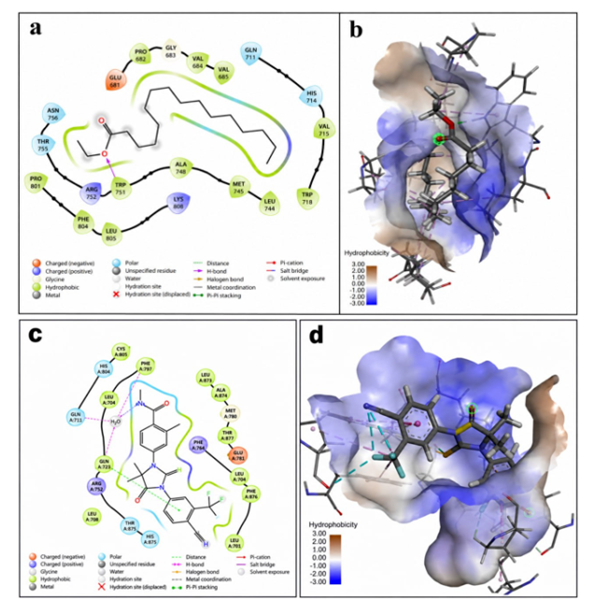
Background: Ficus exasperata (F. exasperata) is used in African traditional medicine for inflammatory and urinary disorders, but its phytochemical interactions with prostate cancer targets remain insufficiently characterized computationally. Objective: This study used network pharmacology, molecular docking, pharmacokinetic prediction, and computational toxicology to explore the predicted anti-prostate cancer potential of F. exasperata leaf ethanol extract. Methods: GC-MS characterized phytochemicals. SwissADME assessed drug-likeness and pharmacokinetics. SwissTargetPrediction identified targets; prostate cancer genes were retrieved from GeneCards, Open Targets, and DisGeNET. GO and KEGG enrichment were performed. Docking and MM-GBSA were done against the androgen receptor (PDB: 2AX6). PASS, ProTox-3.0, and StopTox predicted activities and toxicity. Results: GC-MS identified eight phytoconstituents; two had favorable pharmacokinetics. Network pharmacology located 174 phytochemical targets, 3,388 prostate cancer genes, and 97 common targets. Docking yielded XP Glide scores of −1.866 kcal/mol for hexadecanoic acid, ethyl ester and −2.609 kcal/mol for enzalutamide; XP MM-GBSA values were −38.29 and −31.99 kcal/mol, respectively. PASS predicted testosterone 17β-dehydrogenase inhibition (Pa=0.781), TP53 enhancement (Pa=0.719), and alpha-methylacyl-CoA racemase inhibition (Pa=0.665) for the phytochemical. Toxicity prediction indicated a higher LD50 but possible skin sensitization. Conclusions: Computational analyses suggest F. exasperata phytochemicals may interact with prostate cancer networks and AR. Hexadecanoic acid, ethyl ester warrants further study. These are predictions, not experimental evidence; AR-binding studies, molecular dynamics, cellular assays, and in vivo validation are needed.
Downloads
References
L. Wang, B. Lu, M. He, Y. Wang, Z. Wang, and L. Du, "Prostate cancer incidence and mortality: global status and temporal trends in 89 countries from 2000 to 2019," Frontiers in Public Health, vol. 10, Art no. 811044, Feb. 2022.
E. J. Schafer, M. Laversanne, H. Sung, I. Soerjomataram, A. Briganti, W. Dahut, F. Bray, and A. Jemal, "Recent patterns and trends in global prostate cancer incidence and mortality: An update," European Urology, vol. 87, no. 3, pp. 302–313, 2025.
F. Saad, M. H. Hussain, B. Tombal, K. Fizazi, C. N. Sternberg, E. D. Crawford, L. T. Nordquist, M. Bögemann, R. Tutrone, N. D. Shore, et al., "Deep and durable prostate-specific antigen response to darolutamide with androgen deprivation therapy and docetaxel, and association with clinical outcomes for patients with high- or low-volume metastatic hormone-sensitive prostate cancer: Analyses of the randomized phase 3 ARASENS study," European Urology, vol. 86, no. 4, pp. 329–339, 2024.
J. Guo, K. Wu, Z. Ma, S. Guo, F. Wang, and L. Lu, "Androgen receptor reactivation in castration-resistant prostate cancer: mechanisms, epigenetic adaptation, and therapeutic vulnerabilities," Frontiers in Oncology, vol. 16, Art no. 1837998, May 2026.
J. Xiao, M. Zhang, and D. Wu, "Side effects of prostate cancer therapies and potential management," Journal of Biological Methods, vol. 11, no. 3, Art no. e99010018, 2024.
J. M. Unger, C. Till, C. M. Tangen, D. L. Hershman, P. J. Goodman, M. LeBlanc, W. E. Barlow, R. Vaidya, L. M. Minasian, H. L. Parnes, et al., "Long-term adverse effects and complications after prostate cancer treatment," JAMA Oncology, vol. 10, no. 12, pp. 1654–1662, 2024.
O. T. OGUNMEFUN, "Ficus exasperata (Vahl), a tree of high medicinal value and economic importance – a review," ABUAD International Journal of Natural and Applied Sciences, vol. 5, no. 2, pp. 109–114, 2025.
E. Bafor and O. Igbinuwen, "Acute toxicity studies of the leaf extract of Ficus exasperata on haematological parameters, body weight and body temperature," Journal of Ethnopharmacology, vol. 123, no. 2, pp. 302–307, 2009.
Y. H. Gonfa, F. B. Tessema, A. Bachheti, N. Rai, M. G. Tadesse, A. Nasser Singab, K. K. Chaubey, and R. K. Bachheti, "Anti-inflammatory activity of phytochemicals from medicinal plants and their nanoparticles: a review," Current Research in Biotechnology, vol. 6, Art no. 100152, 2023.
A. Vikhar Danish Ahmad, S. Ayaz Ali, Q. Yasar, N. S. Sakle, and M. Mukhtar Khan, "Integrative network pharmacology, molecular docking, and dynamic simulation analysis of a polyherbal formulation for potential therapeutic impact on prostate cancer," Heliyon, vol. 10, no. 14, Art no. e34531, 2024.
O. O. Babalola, K. Bridget, G. Oyubu, S. A. Waheed, S. A. Ajiboye, A. E. Fakayode, A. A. Edema, U. G. Chukwuma, R. T. Tiamiyu, A. J. Fakayode, et al., "Integrating phytochemicals and in silico methods for modern drug discovery: A comprehensive review," Discover Chemistry, vol. 2, no. 1, Art no. 297, 2025.
S. Chatterjee, P. Saha, P. Ganguly, and A. K. Patel, "A comprehensive review on network-pharmacognosy-based decoding of phytochemical synergy in complex diseases," Revista Brasileira de Farmacognosia, vol. 36, no. 1, Art no. 55, 2026.
P. B. D. Deeh, M. Arumugam, K. Alagarsamy, G. Karanam, N. S. Natesh, P. Watcho, and V. Vishwakarma, "Phyllanthus muellerianus and Ficus exasperata exhibit anti-proliferative and pro-apoptotic activities in human prostate cancer PC-3 cells by modulating calcium influx and activating caspases," Biologia, vol. 77, no. 7, pp. 1981–1994, 2022.
J. D. Manantan, H. J. Sto. Domingo, I. Corpuz, J. K. Ecalne, M. Andal, and M. A. Balendres, "Global research trends on the anticancer potential of Ficus spp.: A bibliometric analysis," Beni-Suef University Journal of Basic and Applied Sciences, vol. 15, no. 1, Art no. 50, 2026.
L. Li and S. Kar, "Leveraging network pharmacology for drug discovery: Integrative approaches and emerging insights," Medicine in Drug Discovery, vol. 27, Art no. 100220, Sep. 2025.
F. Noor, M. Tahir ul Qamar, U. A. Ashfaq, A. Albutti, A. S. S. Alwashmi, and M. A. Aljasir, "Network pharmacology approach for medicinal plants: Review and assessment," Pharmaceuticals, vol. 15, no. 5, Art no. 572, 2022.
R. M. de Angelo, D. S. de Sousa, A. P. da Silva, L. P. A. Chiari, A. B. F. da Silva, and K. M. Honorio, "Molecular docking: State-of-the-art scoring functions and search algorithms," in Computer-Aided and Machine Learning-Driven Drug Design. Springer Nature Switzerland, 2024, vol. 3, pp. 163–198.
V.-K. Tran-Nguyen and A.-C. Camproux, "Computational modeling of protein-ligand interactions: From binding site identification to pose prediction and beyond," Current Opinion in Structural Biology, vol. 95, Art no. 103152, Dec. 2025.
F. Stanzione, I. Giangreco, and J. Cole, "Chapter four—use of molecular docking computational tools in drug discovery," in Progress in Medicinal Chemistry. Elsevier, 2021, vol. 60, pp. 273–343.
N. Kaboudi, T. Shekari, A. Shayanfar, and A. S. Pimentel, "Computational approaches for toxicology and pharmacokinetic properties prediction," Journal of Pharmacokinetics and Pharmacodynamics, vol. 52, no. 5, Art no. 51, 2025.
J. P. B. Arango, D. Y. M. Rodriguez, S. L. Cruz, and G. T. Ocampo, "In silico evaluation of pharmacokinetic properties and molecular docking for the identification of potential anticancer compounds," Computational Biology and Chemistry, vol. 120, Art no. 108626, Feb. 2026.
I. Koo, S. Kim, and X. Zhang, "Comparative analysis of mass spectral matching-based compound identification in gas chromatography–mass spectrometry," Journal of Chromatography A, vol. 1298, pp. 132–138, Jul. 2013.
S. G. Ingle, A. K. Gade, and G. B. Hedawoo, "Systematic review on phytochemicals structure and activity databases," Phytomedicine Plus, vol. 4, no. 4, Art no. 100644, 2024.
M. A. Isa and A. P. Kappo, "Exploring phytoconstituents through molecular dynamics simulation: Uncovering potential inhibitors for multiple targeted pathways in breast cancer," Journal of Proteins and Proteomics, vol. 16, no. 2, pp. 125–140, 2025.
S. A. Akhondi, S. Muresan, A. J. Williams, and J. A. Kors, "Ambiguity of non-systematic chemical identifiers within and between small-molecule databases," Journal of Cheminformatics, vol. 7, no. 1, Art no. 54, 2015.
S. Kim, "Public chemical databases," in Encyclopedia of Bioinformatics and Computational Biology. Elsevier, 2019, vol. 2, pp. 628–639.
A. Daina, O. Michielin, and V. Zoete, "SwissADME: A free web tool to evaluate pharmacokinetics, drug-likeness and medicinal chemistry friendliness of small molecules," Scientific Reports, vol. 7, no. 1, Art no. 42717, 2017.
M. De Las Llagas, L. Santiago, and J. Ramos, "Cytotoxicity and apoptotic activity of Ficus pseudopalma Blanco leaf extracts against human prostate cancer cell lines," Tropical Journal of Pharmaceutical Research, vol. 13, no. 1, pp. 93–100, 2014.
Y. Song, H. Wang, Y. Pan, and T. Liu, "Investigating the multi-target pharmacological mechanism of Hedyotis diffusa Willd acting on prostate cancer: A network pharmacology approach," Biomolecules, vol. 9, no. 10, Art no. 591, 2019.
W.-H. Guo, K. Zhang, and L.-H. Yang, "Potential mechanisms of Pyrrosiae folium in treating prostate cancer based on network pharmacology and molecular docking," Drug Development and Industrial Pharmacy, vol. 48, no. 5, pp. 189–197, 2022.
H. Rahman, A. Rahman, S. Zahan, P. Biswas, A. A. M. Sohag, S. Islam, R. A. I. Reshad, B. Gupta, R. Islam, A. Hannan, et al., "A pharmacoinformatics and molecular dynamics approach to the phytochemical screening of Ficus hispida fruits for prostate cancer therapy," Current Computer-Aided Drug Design, vol. 22, Nov. 2025.
W. Li, H. Jiang, W. Zhang, Q. Sun, Q. Zhang, J. Xu, J. Huang, and Y. Wan, "Mechanisms of action of sappan lignum for prostate cancer treatment: network pharmacology, molecular docking and experimental validation," Frontiers in Pharmacology, vol. 15, Art no. 1407525, Sep. 2024.
National Center for Biotechnology Information, PubChem compound summary for CID 15951529, Enzalutamide, PubChem, Accessed: 2023-03-24, 2023. [Online]. Available: https://pubchem.ncbi.nlm.nih.gov/compound/Enzalutamide.
M. Adnan, M. Nazim Uddin Chy, A. Mostafa Kamal, M. O. K. Azad, A. Paul, S. B. Uddin, J. W. Barlow, M. O. Faruque, C. H. Park, and D. H. Cho, "Investigation of the biological activities and characterization of bioactive constituents of Ophiorrhiza rugosa var. prostrata (D.Don) & Mondal leaves through in vivo, in vitro, and in silico approaches," Molecules, vol. 24, no. 7, Art no. 1367, 2019.
H. Hasnat, S. Alam, S. Akter Shompa, T. Saha, F. T. Richi, M. H. Hossain, A. Zaman, C. Zeng, C. Shao, S. Wang, et al., "Phyto-pharmacological wonders of genus Ficus: Ethnopharmacological insights and phytochemical treasures from natural products," Saudi Pharmaceutical Journal, vol. 32, no. 12, Art no. 102211, 2024.
D. G. Mouho, A. P. Oliveira, C. G. Kodjo, P. Valentão, A. Gil-Izquierdo, P. B. Andrade, Z. A. Ouattara, Y.-A. Bekro, and F. Ferreres, "Chemical findings and in vitro biological studies to uphold the use of Ficus exasperata Vahl leaf and stem bark," Food and Chemical Toxicology, vol. 112, pp. 134–144, Feb. 2018.
B. A. Asue, L. E. Abongwa, M. G. Annih, B. H. Narcisse, V. T. Mayoudom, D. J. Fomnboh, L. B. Fokunang, N. N. Borgia, E. Tembe-Fokunang, B. Ngameni, et al., "Phytochemical analysis of bioactive compounds of the leaf extracts of Ficus exasperata Vahl. (Moraceae)," Journal of Complementary and Alternative Medical Research, vol. 26, no. 5, pp. 1–16, 2025.
N. Mokhtar, F. Mohamed Tap, N. H. Ahmad Rozani, N. B. Ahmad Khairudin, and R. Rasit Ali, "Phytochemical profiling, pharmacology prediction, and molecular docking study of Chromolaena odorata extract against multiple target proteins in wound healing," Journal of Herbmed Pharmacology, vol. 12, no. 4, pp. 469–482, 2023.
D. I. Akinloye, C. A. Moses, E. U. Alum, T. A. Jarikre, T. A. Adeosun, A. T. Kolawole, I. S. Awonaiya, E. O. Odeniyi, and O. A. Akinloye, "Chelesta-8,24-dien-3-ol in Ficus exasperata leaves enhances the prevention of sodium nitrite-induced hypoxia by binding to HIF-1 and NF-κB," Scientific Reports, vol. 16, no. 1, Art no. 4822, 2026.
O. E. Adeyemi, K. H. Jaryum, and T. O. Johnson, "Elucidation and active ingredient identification of aqueous extract of Ficus exasperata Vahl leaf against bisphenol A-induced toxicity through in vivo and in silico assessments," In Silico Pharmacology, vol. 12, no. 2, Art no. 73, 2024.
National Center for Biotechnology Information, PubChem compound summary for CID 5367460, ethyl linolenate, PubChem, Accessed: 2024-12-11, 2024. [Online]. Available: https://pubchem.ncbi.nlm.nih.gov/compound/Ethyl-linolenate.
A. R. Golshayan and E. S. Antonarakis, "Enzalutamide: an evidence-based review of its use in the treatment of prostate cancer," Core Evidence, vol. 8, pp. 27–35, Apr. 2013.
Y. Wang, J. Kreisberg, and P. Ghosh, "Cross-talk between the androgen receptor and the phosphatidylinositol 3-kinase/AKT pathway in prostate cancer," Current Cancer Drug Targets, vol. 7, no. 6, pp. 591–604, 2007.
E. Tortorella, S. Giantulli, A. Sciarra, and I. Silvestri, "AR and PI3K/AKT in prostate cancer: A tale of two interconnected pathways," International Journal of Molecular Sciences, vol. 24, no. 3, Art no. 2046, 2023.
Y. Yang, Z. Zhang, S. Li, X. Ye, X. Li, and K. He, "Synergy effects of herb extracts: pharmacokinetics and pharmacodynamic basis," Fitoterapia, vol. 92, pp. 133–147, Jan. 2014.
L. Thamanna and P. Chellapandi, "Network pharmacology identifies repurposable drugs targeting host pathways across the oral-gut-lung axis," Naunyn-Schmiedeberg’s Archives of Pharmacology, vol. 399, no. 11, pp. 18095–18117, 2026.
I. A. Akinwumi and O. A. Ambali, "Exploring synergistic effects of bioactive compounds and pharmaceuticals in therapeutic applications," Journal of Holistic Integrative Pharmacy, vol. 7, no. 1, pp. 102–110, 2026.
Downloads
Key Dates
Received
Revised
Accepted
Published
Data Availability Statement
The data supporting the findings of this study are included within the article. All computational data, including phytochemical, pharmacokinetic, network pharmacology, molecular docking, and toxicity prediction results, are available from the corresponding author upon reasonable request.
Issue
Section
License
Copyright (c) 2026 Mutiu A. Alabi, Habeebullah A. Jamiu, Dauda S. Adebara, Akeem O. Salawu, AbdulJeleel A. Yusuph, Abdulhameed O. Alli, Fatai A. Kareem, Emmanuel O. Ajani

This work is licensed under a Creative Commons Attribution 4.0 International License.
(Starting May 5, 2024) Authors retain copyright and grant the journal right of first publication with the work simultaneously licensed under a Creative Commons Attribution (CC-BY) 4.0 License that allows others to share the work with an acknowledgement of the work’s authorship and initial publication in this journal.
How to Cite