Clove Oil Nanoemulsion Versus Alcoholic Extract: Preparation, Characterization, and Comparative Anticancer Efficacy Against Gastric Cancer Cells
DOI:
https://doi.org/10.23851/mjs.v37i2.1821Keywords:
Alcoholic extract, Clove oil, Nanoemulsion, Anticancer activity, Gastric Cancer CellsAbstract
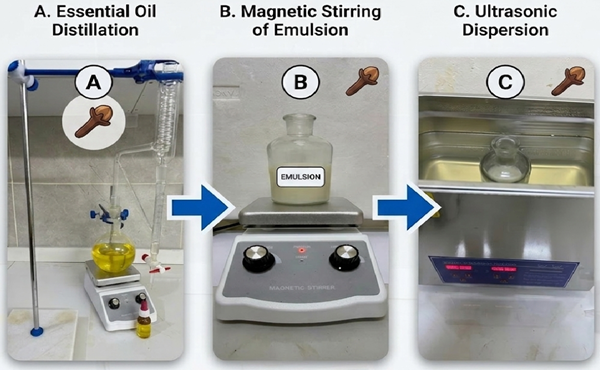
Background: Gastric cancer is a global health issue, and efforts are being made to discover new compounds that can be used to treat or prevent this disease. Clove (Syzygium aromaticum) contains eugenol and other bioactive compounds that have antioxidant and anticancer effects. The use of nanoemulsion technology can help to improve the solubility, stability, and bioavailability of these natural compounds, which in turn may enhance their therapeutic ability. Objective: This study aimed to compare the chemical composition and anticancer activity of clove oil nanoemulsions and alcoholic clove extract against human gastric cancer cells. Methods: Both clove oil nanoemulsion and alcoholic extract were prepared using standardized methods, with 50% ethanol employed for the extraction of active compounds. The samples were characterized by dynamic light scattering (DLS) for particle size analysis and Fourier-transform infrared spectroscopy (FTIR) for identification of functional groups and structural features. Their anticancer activity was evaluated using the MTT assay on a gastric cancer cell line by testing multiple concentrations and assessing effects on cell viability. Results: FTIR analysis revealed the presence of key functional groups in both the nanoemulsion and the alcoholic extract, such as phenolic hydroxyl groups (O–H) and aromatic bonds (C=C), confirming the presence of eugenol as the main active ingredient in both preparations. However, the nanoemulsion exhibited higher spectral intensity and a better distribution of nonpolar compounds, indicating improved solubility and stability of the active compounds. Both samples demonstrated antioxidant activity and the ability to inhibit the growth of gastric cancer cells. The nanoemulsion was found to have significantly higher potency compared to the alcoholic extract, with an IC50 value of 36.30±1.47 μg/mL compared to 41.67±1.53 μg/mL for the extract. Conclusions: This difference is attributable to enhanced solubility, stability and cellular uptake of the active compounds in the nanoemulsion. The results suggest that clove oil nanoemulsions exhibit superior antioxidant properties and anticancer activity compared to conventional alcoholic extracts indicating that nanotechnology and traditional methods together present a unique opportunity for improving bioactivity and bioavailability of natural anticancer agents, which could lead to the development of effective therapies as treatment options for gastric cancer.
Downloads
References
F. Bray, J. Ferlay, I. Soerjomataram, R. L. Siegel, L. A. Torre, and A. Jemal, “Global cancer statistics 2018: GLOBOCAN estimates of incidence and mortality worldwide for 36 cancers in 185 countries,” CA: A Cancer Journal for Clinicians, vol. 68, no. 6, pp. 394–424, 2018.
CrossRef | Google Scholar | PubMed DOI: https://doi.org/10.3322/caac.21492
D. J. Newman and G. M. Cragg, “Natural products as sources of new drugs over the nearly four decades from 01/1981 to 09/2019,” Journal of Natural Products, vol. 83, no. 3, pp. 770–803, 2020.
CrossRef | Google Scholar | PubMed DOI: https://doi.org/10.1021/acs.jnatprod.9b01285
A. T. Zari, T. A. Zari, and K. R. Hakeem, “Anticancer properties of eugenol: A review,” Molecules, vol. 26, no. 23, Art no. 7407, 2021.
CrossRef | Google Scholar | PubMed DOI: https://doi.org/10.3390/molecules26237407
C. Li, H. Xu, X. Chen, J. Chen, X. Li, G. Qiao, Y. Tian, R. Yuan, S. Su, X. Liu, et al., “Aqueous extract of clove inhibits tumor growth by inducing autophagy through AMPK/ULK pathway,” Phytotherapy Research, vol. 33, no. 7, pp. 1794–1804, 2019.
CrossRef | Google Scholar | PubMed DOI: https://doi.org/10.1002/ptr.6367
P. Happy Kurnia, E. Andika Bachtiar, Q. Faqrizal Ria, F. Fadhil, and D. Anita, “Eugenol isolated from Syzygium aromaticum inhibits HeLa cancer cell migration by altering epithelial-mesenchymal transition protein regulators,” Journal of Applied Pharmaceutical Science, vol. 11, no. 5, pp. 049–053, 2021.
CrossRef | Google Scholar DOI: https://doi.org/10.7324/JAPS.2021.110507
H. Sun, D. Luo, S. Zheng, Z. Li, and W. Xu, “Antimicrobial behavior and mechanism of clove oil nanoemulsion,” Journal of Food Science and Technology, vol. 59, no. 5, pp. 1939–1947, 2022.
CrossRef | Google Scholar | PubMed DOI: https://doi.org/10.1007/s13197-021-05208-z
Z. A. Fadhil, E. E. Mohammad Amin, S. Mohammed Mahmood, and A. Hamied Hussein, “Preparation of a nanoemulsion from clove oil extract containing phenol and studying its effect on a human MCF-7 breast cancer cell line,” Salud, Ciencia y Tecnología, vol. 5, Art no. 1535, Apr. 2025.
CrossRef | Google Scholar DOI: https://doi.org/10.56294/saludcyt20251535
A. Karimi, M. Moradi, L. Hashemi, S. Alidadi, and A. Soltani, “In vitro anti-proliferative activity of clove extract on human gastric carcinoma,” Research Journal of Pharmacognosy, vol. 4, no. 4, pp. 41–48, 2017.
Google Scholar | Link
M. T. Tunç and İ. Koca, “Ohmic heating assisted hydrodistillation of clove essential oil,” Industrial Crops and Products, vol. 141, Art no. 111763, Dec. 2019.
CrossRef | Google Scholar DOI: https://doi.org/10.1016/j.indcrop.2019.111763
A. H. Hussein, “Studying the effect of thymol-containing nanoemulsion extracted from thyme on angiogenesis controlling genes VEGF and VEGFR in a human liver cancer cell line,” Baghdad Science Journal, vol. 22, no. 4, pp. 1151–1162, 2024.
CrossRef | Google Scholar DOI: https://doi.org/10.21123/bsj.2024.10591
M. A. Alaadin, G. A. Hammood, S. T. Adday, A. H. Hussein, and A. H. Nouri, “Synthesis of carbon nanoparticles from glucose, evaluation of their phenol adsorption capacity, and study their potential as drug delivery systems for treating human pancreatic cancer cells,” Applied Chemical Engineering, vol. 8, no. 3, Art no. ACE-5702, 2025.
CrossRef DOI: https://doi.org/10.59429/ace.v8i3.5702
R. J. Wilson, Y. Li, G. Yang, and C.-X. Zhao, “Nanoemulsions for drug delivery,” Particuology, vol. 64, pp. 85–97, May 2022.
CrossRef | Google Scholar DOI: https://doi.org/10.1016/j.partic.2021.05.009
J. N. Haro-González, B. N. Schlienger de Alba, M. Martínez-Velázquez, G. A. Castillo-Herrera, and H. Espinosa-Andrews, “Optimization of clove oil nanoemulsions: Evaluation of antioxidant, antimicrobial, and anticancer properties,” Colloids and Interfaces, vol. 7, no. 4, Art no. 64, 2023.
CrossRef | Google Scholar DOI: https://doi.org/10.3390/colloids7040064
A. M. Shehabeldine, A. S. Doghish, W. A. El-Dakroury, M. M. H. Hassanin, A. A. Al-Askar, H. AbdElgawad, and A. H. Hashem, “Antimicrobial, antibiofilm, and anticancer activities of Syzygium aromaticum essential oil nanoemulsion,” Molecules, vol. 28, no. 15, Art no. 5812, 2023.
CrossRef | Google Scholar | PubMed DOI: https://doi.org/10.3390/molecules28155812
R. Yadav, H. S. Chawra, G. Dubey, M. S. Alam, V. Kumar, P. Sharma, N. K. Upadhayay, and T. Yadav, “Herbal based nanoparticles as a possible and potential treatment of cancer: A review,” Exploration of Targeted Anti-tumor Therapy, vol. 6, Art no. 1002285, Jan. 2025.
CrossRef | Google Scholar | PubMed DOI: https://doi.org/10.37349/etat.2025.1002285
R. Ghosh, S. A. R. Rizvi, N. Afroz, S. H. Naqvi, and S. Wajid, “Nanoemulsion formulation based delivery system enhances anticancer efficacy of pumpkin seed oil against prostate cancer,” Frontiers in Nanotechnology, vol. 8, Art no. 1805394, Mar. 2026.
CrossRef | Google Scholar DOI: https://doi.org/10.3389/fnano.2026.1805394
E. Sánchez-López, M. Guerra, J. Dias-Ferreira, A. Lopez-Machado, M. Ettcheto, A. Cano, M. Espina, A. Camins, M. L. Garcia, and E. B. Souto, “Current applications of nanoemulsions in cancer therapeutics,” Nanomaterials, vol. 9, no. 6, Art no. 821, 2019.
CrossRef | Google Scholar | PubMed DOI: https://doi.org/10.3390/nano9060821
M. K. Anwer, S. Jamil, E. O. Ibnouf, and F. Shakeel, “Enhanced antibacterial effects of clove essential oil by nanoemulsion,” Journal of Oleo Science, vol. 63, no. 4, pp. 347–354, 2014.
CrossRef | Google Scholar | PubMed DOI: https://doi.org/10.5650/jos.ess13213
İ. Tarhan, M. R. Bakır, O. Kalkan, M. Yöntem, and H. Kara, “Rapid determination of adulteration of clove essential oil with benzyl alcohol and ethyl acetate: Towards quality control analysis by FTIR with chemometrics,” Vibrational Spectroscopy, vol. 118, Art no. 103339, Jan. 2022.
CrossRef | Google Scholar DOI: https://doi.org/10.1016/j.vibspec.2022.103339
R. Hemalatha, P. Nivetha, C. Mohanapriya, G. Sharmila, C. Muthukumaran, and M. Gopinath, “Phytochemical composition, GC-MS analysis, in vitro antioxidant and antibacterial potential of clove flower bud (Eugenia caryophyllus) methanolic extract,” Journal of Food Science and Technology, vol. 53, no. 2, pp. 1189–1198, 2015.
CrossRef | Google Scholar | PubMed DOI: https://doi.org/10.1007/s13197-015-2108-5
J. Ahamad, “Characterization of essential oil composition of Syzygium aromaticum Linn. (clove) by GC-MS and evaluation of its antioxidant activity,” Journal of Angiotherapy, vol. 7, no. 1, pp. 1–5, 2023.
CrossRef | Google Scholar DOI: https://doi.org/10.25163/angiotherapy.719358
H. P. Kusumaningrum, G. W. Agung, F. S. Khoirudin, L. Khoiriyah, A. F. Amrullah, F. Hanifah, H. A. Listyanto, M. Zainuri, I. N. Widiasa, and I. Gunawan, “Analysis of chemical compound in essential oil from clove stem using the FTIR and GC-MS methods,” in Advances in Intelligent Applications and Innovative Approach, vol. 2760, AIP Publishing, 2023, Art no. 040028.
CrossRef | Google Scholar DOI: https://doi.org/10.1063/5.0140220
B. G. Prajapati, A. Parihar, M. Macwan, and S. Pal, “A comprehensive review on applications, preparation & characterization of nanoemulsion,” IP International Journal of Comprehensive and Advanced Pharmacology, vol. 8, no. 2, pp. 104–111, 2023.
CrossRef | Google Scholar DOI: https://doi.org/10.18231/j.ijcaap.2023.018
A. Dimaki, L. Lazaridou, K. Vakalou, V. Zervas, D. Bartzi, K. Tsagkidou, P. D. Papadopoulos, K. E. Koumarelas, and G. Christodoulidis, “Natural compounds in gastric cancer therapy: Molecular mechanisms and potential treatment options,” International Journal of Molecular Sciences, vol. 27, no. 2, Art no. 753, 2026.
CrossRef | Google Scholar | PubMed DOI: https://doi.org/10.3390/ijms27020753
Z. A. Lone and N. K. Jain, “Phytochemical analysis of clove (Syzygium aromaticum) dried flower buds extract and its therapeutic importance,” Journal of Drug Delivery and Therapeutics, vol. 12, no. 4-S, pp. 87–92, 2022.
CrossRef | Google Scholar DOI: https://doi.org/10.22270/jddt.v12i4-S.5628
L. Salvia-Trujillo, A. Rojas-Graü, R. Soliva-Fortuny, and O. Martín-Belloso, “Physicochemical characterization and antimicrobial activity of food-grade emulsions and nanoemulsions incorporating essential oils,” Food Hydrocolloids, vol. 43, pp. 547–556, Jan. 2015.
CrossRef | Google Scholar DOI: https://doi.org/10.1016/j.foodhyd.2014.07.012
J. S. Gava, G. A. Simões, D. B. Portes, J. V. Cruz, A. S. Maddaleno, M. P. Vinardell, M. Mitjans, H. S. França, and M. Fronza, “Nanoemulsification enhances the regenerative and safety profile of Ocimum gratissimum essential oil in vitro,” ACS Omega, vol. 10, no. 39, pp. 45596–45607, 2025.
CrossRef | Google Scholar | PubMed DOI: https://doi.org/10.1021/acsomega.5c05769
U. M. G. Bolgen, S. Demirci Kayiran, Y. Ozogul, and F. Ozogul, “Essential oil-based nanoemulsions with current knowledge: Formulation, characterization, and applications in food and pharmaceuticals,” Industrial Crops and Products, vol. 233, Art no. 121411, Oct. 2025.
CrossRef DOI: https://doi.org/10.1016/j.indcrop.2025.121411
E. Amirinezhadfard, A. N. Tabar, L.-J. Xia, and W.-C. Yang, “Plant-derived nanomaterials in cancer therapy: Advances from green synthesis to application of PANoptosis-mediated tumor suppression,” Industrial Crops and Products, vol. 236, Art no. 121850, Nov. 2025.
CrossRef | Google Scholar DOI: https://doi.org/10.1016/j.indcrop.2025.121850
Downloads
Key Dates
Received
Revised
Accepted
Published
Data Availability Statement
The data that support the findings of this study are available from the corresponding authors upon reasonable request.
Issue
Section
License
Copyright (c) 2026 Zahraa Ibrahim Hameed, Amer Hamied Hussein

This work is licensed under a Creative Commons Attribution 4.0 International License.
(Starting May 5, 2024) Authors retain copyright and grant the journal right of first publication with the work simultaneously licensed under a Creative Commons Attribution (CC-BY) 4.0 License that allows others to share the work with an acknowledgement of the work’s authorship and initial publication in this journal.
How to Cite