Superhydrophobic and High Transmittance Coated Silica Aerogel Prepared in Ambient Pressure as Self-Cleaning Windows
DOI:
https://doi.org/10.23851/mjs.v37i1.1795Keywords:
Silica aerogel, Self-cleaning, Hydrophobicity, FTIR, TransmittanceAbstract
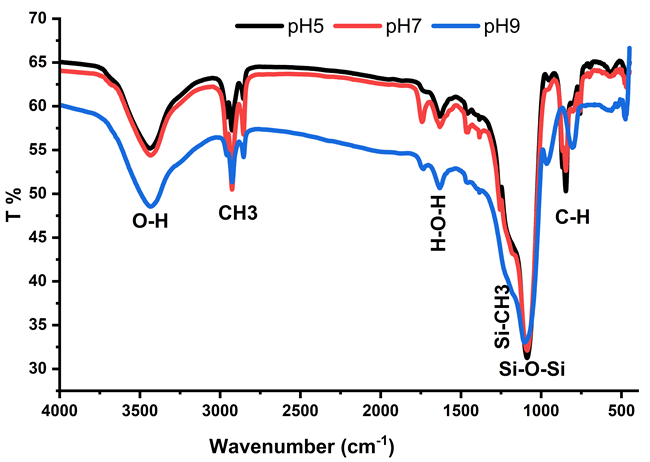
Background: Highly porous nanomaterials have been promising materials in recent years. Silica-based materials have attracted the attention of researchers because they are easy to prepare under normal atmospheric pressure. Furthermore, they have broad practical applications that aim to reduce time and cost. Objective: The current work highlights self-cleaning windows for high buildings that are difficult to access. Hydrophobic silica was prepared, and the surfaces of regular glass were coated with gel during the preparation process, taking into justification that the transparency of the glass would not be affected. Methods: The preparation was carried out under normal atmospheric pressure and for a period of only one week, during which samples of hydrophobic silica were prepared with ratios of the starting material tetraethylorthosilicate (TEOS), ethanol, and hydrochloric acid with 0.5 molar concentration, and taking into account the molar ratios in each case for each of TEOS:ethanol:HCl at ratios of 1:5:0.2. Results: The results of the UV test showed that the transparency ratios of samples changed slightly with a variation when the TEOS ratios were changed. The best result was 95% at pH7 with a volume ratio of 1 TEOS. The contact angle was within the superhydrophobic region at 152° and was best at a value of 1TEOS at pH7. This was confirmed by the FTIR test through the weak beams that return to OH, Si-OH, and H-OH groups. Also, the AFM images showed that the roughness ratios are very good, which enhances the role of the prepared models in practical applications. The differential thermal‐thermogravimetric TGA-data test also confirmed the stability of the samples at a temperature of 217 °C. This is particularly important, as glass is exposed to varying temperatures throughout the year. Conclusions: It can be confirmed that it is possible to obtain superhydrophobic silica coated on glass slides, which exhibit high transparency and thermal stability. This enables it to withstand external conditions such as high temperatures, rain, and dust. Therefore, it is easy to produce self-cleaning glass covers or windows that are resistant to heat and humidity.
Downloads
References
F. Fischer, A. Rigacci, R. Pirard, S. Berthon-Fabry, and P. Achard, “Cellulose-based aerogels,” Polymer, vol. 47, no. 22, pp. 7636–7645, 2006.
CrossRef | Google Scholar
A. B. Rashid, S. I. Shishir, M. A. Mahfuz, M. T. Hossain, and M. E. Hoque, “Silica aerogel: Synthesis, characterization, applications, and recent advancements,” Particle & Particle Systems Characterization, vol. 40, no. 6, Art no. 2200186, 2023.
CrossRef | Google Scholar
A. Hamdi, J. Chalon, P. Laurent, B. Dodin, E. Dogheche, and P. Champagne, “Facile synthesis of fluorine-free, hydrophobic, and highly transparent coatings for self-cleaning applications,” Journal of Coatings Technology and Research, vol. 18, no. 3, pp. 807–818, 2021.
CrossRef | Google Scholar
S. Sonu, N. Rai, and I. Chauhan, “Multifunctional aerogels: A comprehensive review on types, synthesis and applications of aerogels,” Journal of Sol-Gel Science and Technology, vol. 105, no. 2, pp. 324–336, 2023.
CrossRef | Google Scholar
Q. Wang, D. Mahadik, P. Meti, Y.-D. Gong, K.-Y. Lee, and H.-H. Park, “Dioxybenzene-bridged hydrophobic silica aerogels with enhanced textural and mechanical properties,” Microporous and Mesoporous Materials, vol. 294, Art no. 109863, Mar. 2020.
CrossRef | Google Scholar
Y. Wu, D. Ju, H. Wang, H. Zhao, C. Sun, Y. Wu, B. Guo, and Y. Wang, “Modification of surface structure and mechanical properties in polyimide aerogel by low-energy proton implantation,” Surface and Coatings Technology, vol. 403, Art no. 126364, Dec. 2020.
CrossRef | Google Scholar
S. He and X. Chen, “Flexible silica aerogel based on methyltrimethoxysilane with improved mechanical property,” Journal of Non-Crystalline Solids, vol. 463, pp. 6–11, May 2017.
CrossRef | Google Scholar
C. A. Milea, C. Bogatu, and A. Duta, “The influence of parameters in silica sol-gel process,” Bulletin of the Transilvania University of Brasov. Series I-Engineering Sciences, vol. 4, no. 1, pp. 59–66, 2011.
Google Scholar | Link
A. Venkateswara Rao, E. Nilsen, and M.-A. Einarsrud, “Effect of precursors, methylation agents and solvents on the physicochemical properties of silica aerogels prepared by atmospheric pressure drying method,” Journal of Non-Crystalline Solids, vol. 296, no. 3, pp. 165–171, 2001.
CrossRef | Google Scholar
S. Xue, S. Yang, X. Li, Q. Li, and B. Hu, “A comprehensive review on self-cleaning glass surfaces: durability, mechanisms, and functional applications,” RSC Advances, vol. 14, no. 46, pp. 34390–34414, 2024.
CrossRef | Google Scholar | PubMed
A. M. Alattar, I. F. Al-Sharuee, and J. F. Odah, “Laser fragmentation of green tea-synthesized silver nanoparticles and their blood toxicity: Effect of laser wavelength on particle diameters,” Journal of Medical Physics, vol. 49, no. 1, pp. 95–102, 2024.
CrossRef | Google Scholar | PubMed
K. Liu and L. Jiang, “Bio-inspired self-cleaning surfaces,” Annual Review of Materials Research, vol. 42, no. 1, pp. 231–263, 2012.
CrossRef | Google Scholar
C. Zhang, X. Zhang, H. Shen, D. Shuai, X. Xiong, Y. Wang, H. Huang, and Y. Li, “Superior self-cleaning surfaces via the synergy of superhydrophobicity and photocatalytic activity: Principles, synthesis, properties, and applications,” Journal of Cleaner Production, vol. 428, Art no. 139430, Nov. 2023.
CrossRef | Google Scholar
P. B. Wagh, S. V. Ingale, and S. C. Gupta, “Comparison of hydrophobicity studies of silica aerogels using contact angle measurements with water drop method and adsorbed water content measurements made by Karl Fischer’s titration method,” Journal of Sol-Gel Science and Technology, vol. 55, no. 1, pp. 73–78, 2010.
CrossRef | Google Scholar
Ö. Kesmez, “Preparation of hybrid nanocomposite coatings via sol-gel method for hydrophobic and self-cleaning properties,” Journal of Molecular Structure, vol. 1205, Art no. 127572, Apr. 2020.
CrossRef | Google Scholar
K. Li, L. Xu, X. Yuan, H. Pan, L. Wang, Y. Shen, T. Li, and J. Li, “Preparation of self-healing superhydrophobic cotton fabric based on silica aerogel for self-cleaning and oil/water separation,” Journal of Adhesion Science and Technology, vol. 37, no. 14, pp. 2154–2174, 2022.
CrossRef | Google Scholar
S. Li and L. Sun, “Natural logarithm wavelength modulation spectroscopy: A linear method for any large absorbance,” Spectrochimica Acta Part A: Molecular and Biomolecular Spectroscopy, vol. 254, Art no. 119601, Jun. 2021.
CrossRef | Google Scholar | PubMed
E. Juwita, F. A. Sulistiani, M. Y. Darmawan, N. I. Istiqomah, and E. Suharyadi, “Microstructural, optical, and magnetic properties and specific absorption rate of bismuth ferrite/SiO₂ nanoparticles,” Materials Research Express, vol. 9, no. 7, Art no. 076101, 2022.
CrossRef | Google Scholar
W. H. Al-Husseny, I. F. Al-Sharuee, and R. Ali, “Water glass based superhydrophobic silica aerogel in different environmental of preparation,” New Materials, Compounds and Applications, vol. 6, no. 2, pp. 127–139, 2022.
Google Scholar | Link
M. A. Anaad and I. F. Al-Sharuee, “Raman spectroscopy and structural characteristics of fluorescein and coumarin doped silica sol, gel, and aerogel,” New Materials, Compounds and Applications, vol. 7, no. 2, pp. 122–136, 2023.
Google Scholar | Link
B. T. Mekonnen, W. Ding, H. Liu, S. Guo, X. Pang, Z. Ding, and M. H. Seid, “Preparation of aerogel and its application progress in coatings: A mini overview,” Journal of Leather Science and Engineering, vol. 3, no. 1, Art no. 25, 2021.
CrossRef | Google Scholar
M. Perdigoto, R. Martins, N. Rocha, M. Quina, L. Gando-Ferreira, R. Patrício, and L. Durães, “Application of hydrophobic silica based aerogels and xerogels for removal of toxic organic compounds from aqueous solutions,” Journal of Colloid and Interface Science, vol. 380, no. 1, pp. 134–140, 2012.
CrossRef | Google Scholar | PubMed
D. Huang, C. Guo, M. Zhang, and L. Shi, “Characteristics of nanoporous silica aerogel under high temperature from 950 °C to 1200 °C,” Materials & Design, vol. 129, pp. 82–90, Sep. 2017.
CrossRef | Google Scholar
F. J. Sotomayor, K. A. Cychosz, and M. Thommes, “Characterization of micro/mesoporous materials by physisorption: Concepts and case studies,” Accounts of Materials & Surface Research, vol. 3, no. 2, pp. 34–50, 2018.
Google Scholar | Link
U. K. H. Bangi, M. S. Kavale, S. Baek, and H.-H. Park, “Synthesis of MWCNTs doped sodium silicate-based aerogels by ambient pressure drying,” Journal of Sol-Gel Science and Technology, vol. 62, no. 2, pp. 201–207, 2012.
CrossRef | Google Scholar
W. H. Al-Husseny, I. F. Al-Sharuee, and B. R. Ali, “Spectral and structural analysis for sodium silicate-based aerogel via normal drying pressure,” Malaysian Journal of Science, vol. 42, no. 2, pp. 47–55, 2023.
CrossRef | Google Scholar
Y. Chen and Q. Yu, “Surface modification of miscanthus fiber with hydrophobic silica aerogel for high performance bio-lightweight concrete,” Construction and Building Materials, vol. 411, Art no. 134478, Jan. 2024.
CrossRef | Google Scholar
T. Sugama and T. Pyatina, “Hydrophobic lightweight cement with thermal shock resistance and thermal insulating properties for energy-storage geothermal well systems,” Materials, vol. 14, no. 21, Art no. 6679, 2021.
CrossRef | Google Scholar | PubMed
A. Aminoroaya, R. Bagheri, S. Nouri Khorasani, Z. Talebi, P. Derakhshanfar, and R. Esmaeely Neisiany, “Mesoporous silica aerogel reinforced dental composite: Effects of microstructure and surface modification,” Journal of the Mechanical Behavior of Biomedical Materials, vol. 125, Art no. 104947, Jan. 2022.
CrossRef | Google Scholar | PubMed
Downloads
Key Dates
Received
Revised
Accepted
Published
Data Availability Statement
The data that support the findings of this study are available from the corresponding authors upon reasonable request.
Issue
Section
License
Copyright (c) 2026 Huda Salh Mahdi, Israa F. Al-sharuee

This work is licensed under a Creative Commons Attribution 4.0 International License.
(Starting May 5, 2024) Authors retain copyright and grant the journal right of first publication with the work simultaneously licensed under a Creative Commons Attribution (CC-BY) 4.0 License that allows others to share the work with an acknowledgement of the work’s authorship and initial publication in this journal.
How to Cite