A New Fractional Predator–Prey Model for Studying the Dynamic Relationship between Financial Corruption and Society-Simulation Study
DOI:
https://doi.org/10.23851/mjs.v36i4.1722Keywords:
Boundary value problems, Fractional differential equations, Fixed-point theorem, Krasnoselskii’s theorem, Predator–prey modelAbstract
Background: This study investigates the existence and uniqueness of solutions for a class of nonlinear fractional differential systems governed by Caputo derivatives. Such systems are effective in modeling dynamic processes with hereditary behaviors and anomalous responses, which are commonly observed in socio-economic, biological, and engineering contexts. Traditional integer-order differential models fail to capture these features, motivating the use of fractional-order formulations. Objective: The primary goal is to establish rigorous mathematical conditions ensuring the well-posedness of nonlinear fractional systems involving coupled variables. By proving existence and uniqueness, the study provides a solid theoretical foundation for analysis, simulation, and application of fractional-order models to complex systems with hereditary dynamics. Methods: The fractional differential system is transformed into an equivalent integral formulation using Riemann–Liouville fractional integral operators. Within a Banach space, two operators are defined: one is continuous and compact, while the other is contractive. The existence of solutions is established via Krasnoselskii’s fixed point theorem, and the boundedness and Lipschitz continuity of the nonlinear terms ensure uniqueness through Banach’s contraction principle. The system admits a unique solution confined to a closed, invariant subset of the function space, providing a rigorous framework for analytical and numerical investigations. Results: Analytical results confirm that the proposed fractional-order system satisfies conditions for existence and uniqueness of solutions. The integral representation demonstrates the well-posedness of the model and validates its ability to capture hereditary dynamics accurately. Operator-based analysis ensures stability and supports convergence of numerical methods, making the model practically applicable for simulations of socio-economic and biological processes. Conclusions: This work establishes a rigorous theoretical foundation for nonlinear fractional differential systems with Caputo derivatives. By addressing existence, uniqueness, and stability, it provides a reliable framework for modeling systems where past states influence current behavior. The findings facilitate both analytical and numerical studies of fractional-order dynamics, expanding the applicability of fractional calculus in diverse fields, including economics, population dynamics, control theory, and material science.
Downloads
References
A. S. Haning Puspita, S. Sutrima, R. Setiyowati, and S. Wibowo, “Stability analysis of cellular operating system market share in Indonesia with the competitive Lotka-Volterra model,” Barekeng: Jurnal Ilmu Matematika dan Terapan, vol. 18, no. 1, pp. 0333–0340, 2024.
CrossRef | Google Scholar
A. Ogundero, S. Connelly, and W. T. Sloan, “Developing Lotka-Volterra based models to describe Bdellovibrio predation in a batch and Chemostat experimental system,” Environmental Microbiology Reports, vol. 17, no. 4, Art no. e70141, 2025.
CrossRef | Google Scholar | PubMed
M. H. Al- Towaiq, “An analysis of a numerical solution of the Lotka-Volterra predator-prey model,” The Eurasia Proceedings of Science Technology Engineering and Mathematics, vol. 34, pp. 352–358, Aug. 2025.
CrossRef | Google Scholar
J. Ripoll and J. Font, “Numerical approach to an age-structured Lotka-Volterra model,” Mathematical Biosciences and Engineering, vol. 20, no. 9, pp. 15603–15622, 2023.
CrossRef | Google Scholar | PubMed
A. Bondesan, M. Menale, G. Toscani, and M. Zanella, “Lotka-Volterra-type kinetic equations for interacting species,” Nonlinearity, vol. 38, no. 7, Art no. 075026, 2025.
CrossRef | Google Scholar
J. D. Davis, D. V. Olivença, S. P. Brown, and E. O. Voit, “Methods of quantifying interactions among populations using Lotka-Volterra models,” Frontiers in Systems Biology, vol. 2, Art no. 1021897, Oct. 2022.
CrossRef | Google Scholar
S. Kekulthotuwage Don, K. Burrage, K. J. Helmstedt, and P. M. Burrage, “Stability switching in Lotka-Volterra and ricker-type predator-prey systems with arbitrary step size,” Axioms, vol. 12, no. 4, Art no. 390, 2023.
CrossRef | Google Scholar
X. Cai, “The research history of population models,” Mathematical Modeling and Algorithm Application, vol. 2, no. 1, pp. 57–60, 2024.
CrossRef
A. Genda, A. Fidlin, S. Lenci, and O. Gendelman, “Effects of seasonal hunting and food quantity variations on the Lotka-Volterra model,” Nonlinear Dynamics, vol. 113, no. 10, pp. 12351–12369, 2024.
CrossRef | Google Scholar
É. Diz-Pita and M. V. Otero-Espinar, “Predator-prey models: A review of some recent advances,” Mathematics, vol. 9, no. 15, Art no. 1783, 2021.
CrossRef | Google Scholar
A. Al-Saffar and E.-j. Kim, “Fisher information approach to understand the Gompertz model,” Mathematics in Applied Sciences and Engineering, vol. 3, no. 4, pp. 269–279, 2022.
CrossRef | Google Scholar
J. Wang and W. Jiang, “Impulsive perturbations in a predator-prey model with dormancy of predators,” Applied Mathematical Modelling, vol. 38, no. 9–10, pp. 2533–2542, 2014.
CrossRef | Google Scholar
S. Das and P. Gupta, “A mathematical model on fractional Lotka-Volterra equations,” Journal of Theoretical Biology, vol. 277, no. 1, pp. 1–6, 2011.
CrossRef | Google Scholar | PubMed
H. Abdelhamid, G. Stamov, M. S. Souid, and I. Stamova, “New results achieved for fractional differential equations with Riemann-Liouville derivatives of nonlinear variable order,” Axioms, vol. 12, no. 9, Art no. 895, 2023.
CrossRef | Google Scholar
A. Ganesh, S. Deepa, D. Baleanu, S. S. Santra, O. Moaaz, V. Govindan, and R. Ali, “Hyers-Ulam-Mittag-Leffler stability of fractional differential equations with two Caputo derivative using fractional Fourier transform,” AIMS Mathematics, vol. 7, no. 2, pp. 1791–1810, 2022.
CrossRef | Google Scholar
A. Alsaedi, A. F. Albideewi, S. K. Ntouyas, and B. Ahmad, “On Caputo-Riemann-Liouville type fractional integro-differential equations with multi-point sub-strip boundary conditions,” Mathematics, vol. 8, no. 11, Art no. 1899, 2020.
CrossRef | Google Scholar
A. Chikrii and I. Matychyn, “Riemann-Liouville, Caputo, and sequential fractional derivatives in differential games,” in Advances in Dynamic Games. Birkhäuser Boston, Nov. 2010, pp. 61–81.
CrossRef | Google Scholar
M. Caputo, “Linear models of dissipation whose Q is almost frequency independent-II,” Geophysical Journal International, vol. 13, no. 5, pp. 529–539, 1967.
CrossRef | Google Scholar
N. A. Hamal, “Analysis of mixed differential equations involving the Caputo and Riemann-Liouville fractional derivatives,” Miskolc Mathematical Notes, vol. 26, no. 1, Art no. 291, 2025.
CrossRef | Google Scholar
S. Ryehan, “Numerically unveiling hidden chaotic dynamics in nonlinear differential equations with Riemann-Liouville, Caputo-Fabrizio, and Atangana-Baleanu fractional derivatives,” arXiv, pp. 1–11, 2023.
arXiv | Google Scholar
P. A. Naik, S. Naveen, V. Parthiban, S. Qureshi, M. Alquran, and M. Senol, “Advancing Lotka-Volterra system simulation with variable fractional order Caputo derivative for enhanced dynamic analysis,” Journal of Applied Analysis & Computation, vol. 15, no. 2, pp. 1002–1019, 2025.
CrossRef | Google Scholar
M. Yamamoto, “Fractional calculus and time-fractional differential equations: Revisit and construction of a theory,” Mathematics, vol. 10, no. 5, Art no. 698, 2022.
CrossRef | Google Scholar
D. M. Abdullah and F. Y. Ishak, “A novel Lotka-Volterra model for analyzing the dynamic relationship between financial corruption and society,” AL-Rafidain Journal of Computer Sciences and Mathematics, vol. 19, no. 1, pp. 144–153, 2025.
CrossRef | Google Scholar
Fatmawati, M. A. Khan, M. Azizah, Windarto, and S. Ullah, “A fractional model for the dynamics of competition between commercial and rural banks in Indonesia,” Chaos, Solitons & Fractals, vol. 122, pp. 32–46, May 2019.
CrossRef | Google Scholar
J. Alebraheem, “Dynamics of a predator-prey model with the effect of oscillation of immigration of the prey,” Diversity, vol. 13, no. 1, Art no. 23, 2021.
CrossRef | Google Scholar
V. Kiryakova and Y. Luchko, “Riemann-Liouville and Caputo type multiple Erdélyi-Kober operators,” Open Physics, vol. 11, no. 10, pp. 1314–1336, 2013.
CrossRef | Google Scholar
F. Y. Ishak, “Existence and uniqueness solution for three-point Hadamard-type fractional Volterra BVP,” E-Jurnal Matematika, vol. 11, no. 1, Art no. 70, 2022.
CrossRef | Google Scholar
B. Ahmad and J. J. Nieto, “Existence results for nonlinear boundary value problems of fractional integrodifferential equations with integral boundary conditions,” Boundary Value Problems, vol. 2009, Art no. 708576, 2009.
CrossRef | Google Scholar
Downloads
Key Dates
Received
Revised
Accepted
Published
Data Availability Statement
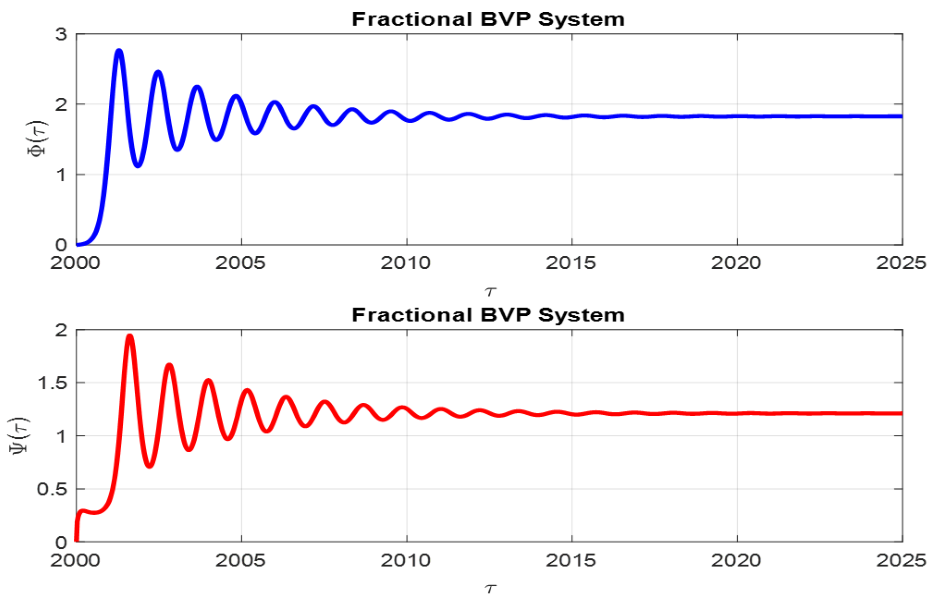
The MATLAB program was used to generate and analyze simulation graphs. Since no empirical data were available for this study, synthetic data produced through simulation were employed to demonstrate the dynamic behavior and interactions between the model variables. Therefore, no real-world datasets were generated or analyzed in this research.
Issue
Section
License
Copyright (c) 2025 Dilbar M. Sharif Abdullah, Faraj Y. Ishak

This work is licensed under a Creative Commons Attribution 4.0 International License.
(Starting May 5, 2024) Authors retain copyright and grant the journal right of first publication with the work simultaneously licensed under a Creative Commons Attribution (CC-BY) 4.0 License that allows others to share the work with an acknowledgement of the work’s authorship and initial publication in this journal.
How to Cite