Sub-Inhibitory Exposure to Meropenem Upregulates Virulence Gene Expression in Carbapenem Resistant Klebsiella oxytoca
DOI:
https://doi.org/10.23851/mjs.v37i1.1814Keywords:
Klebsiella oxytoca, Carbapenem resistance, Biofilm, Virulence genes, MeropenemAbstract
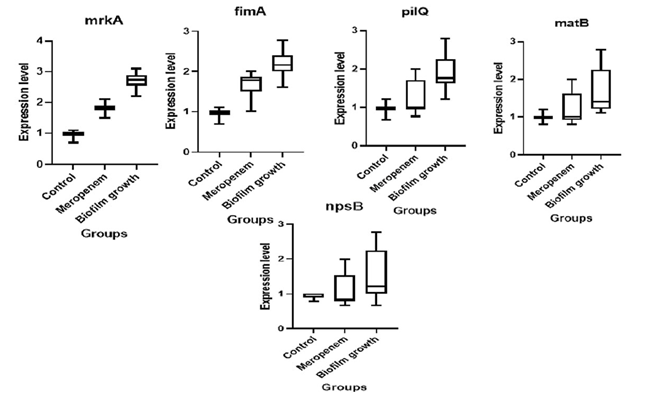
Background: Klebsiella oxytoca (K. oxytoca) is an opportunistic Gram-negative pathogen that is becoming linked to healthcare-associated infections. The development of carbapenem-resistant strains is a major cause for concern in the clinical setting. Sub-inhibitory concentrations (sub-MICs) of antibiotics have been shown to affect the virulence and the formation of biofilms for bacteria. Objective: This study was designed to assess the effect of sub-MIC levels of meropenem on the expression of some virulence genes in carbapenem-resistant K. oxytoca. Methods: Ten clinical isolates of carbapenem-resistant K. oxytoca were isolated from patients diagnosed with hemorrhagic colitis. Isolates were determined by phenotypic, biochemical, and molecular techniques. Antibiotic susceptibility testing and minimum inhibitory concentration (MIC) determination were done based on the CLSI guidelines. Biofilm formation was measured by using the microtiter plate assay. The expression of virulence-associated genes (mrkA, fimA, pilQ, matB, and npsB) was studied by means of quantitative real-time PCR (RT-qPCR) under planktonic and biofilm growth conditions and after exposure to sub-MIC concentrations of the antibiotic meropenem. Results: All isolates were resistant to multiple drugs but sensitive to colistin, fosfomycin, and nitrofurantoin. Biofilm formation assays showed that all the isolates were moderate producers of biofilm. Gene expression analysis showed that virulence genes were significantly more expressed in biofilm than in planktonic condition, i.e., mrkA (2.6-fold), fimA (2.2-fold), pilQ (1.6-fold), matB (1.4-fold), and npsB (1.2-fold). Exposure to sub-MIC meropenem led to further expression of mrkA (1.8-fold) and fimA (1.6-fold). Conclusions: The results suggest that the expression of virulence-associated genes in carbapenem-resistant K. oxytoca can be increased by biofilm growth and sub-MIC antibiotic exposure. These results call on the potential function of sub-therapeutic levels of antibiotics in modulating the pathogenicity of bacterial
pathogens.
Downloads
References
A. Darby, K. Lertpiriyapong, U. Sarkar, U. Seneviratne, D. S. Park, E. R. Gamazon, C. Batchelder, C. Cheung, E. M. Buckley, N. S. Taylor, et al., “Cytotoxic and pathogenic properties of Klebsiella oxytoca isolated from laboratory animals,” PLoS ONE, vol. 9, no. 7, Art no. e100542, 2014.
CrossRef | Google Scholar | PubMed
L. Ni, Z. Zhang, R. Shen, X. Liu, X. Li, B. Chen, X. Wu, H. Li, X. Xie, and S. Huang, “Disinfection strategies for carbapenem-resistant Klebsiella pneumoniae in a healthcare facility,” Antibiotics, vol. 11, no. 6, Art no. 736, 2022.
CrossRef | Google Scholar | PubMed
A. Papanikolopoulou, L. Vini, A. Stoupis, D. Kalimeri, A. Pangalis, G. Chronopoulou, N. Pantazis, P. Gargalianos-Kakolyris, and M. Kantzanou, “Carbapenem-resistant Klebsiella pneumoniae bacteremia: Counterbalance between the endemic load and the infection control program in a hospital,” Acta Microbiologica Hellenica, vol. 69, no. 2, pp. 81–92, 2024.
CrossRef | Google Scholar
Y.-L. Jiang, Y.-Y. Lyu, L.-L. Liu, Z.-P. Li, D. Liu, J.-H. Tai, X.-Q. Hu, W.-H. Zhang, W.-W. Chu, X. Zhao, et al., “Carbapenem-resistant Klebsiella oxytoca transmission linked to preoperative shaving in emergency neurosurgery, tracked by rapid detection via chromogenic medium and whole genome sequencing,” Frontiers in Cellular and Infection Microbiology, vol. 14, Art no. 1464411, Oct. 2024.
CrossRef | Google Scholar | PubMed
Y. Hu, C. Liu, Z. Shen, H. Zhou, J. Cao, S. Chen, H. Lv, M. Zhou, Q. Wang, L. Sun, et al., “Prevalence, risk factors and molecular epidemiology of carbapenem-resistant Klebsiella pneumoniae in patients from Zhejiang, China, 2008–2018,” Emerging Microbes & Infections, vol. 9, no. 1, pp. 1771–1779, 2020.
CrossRef | Google Scholar | PubMed
W. Huang, F. Qiao, Y. Deng, S. Zhu, J. Li, Z. Zong, and W. Zhang, “Analysis of risk factors associated with healthcare-associated carbapenem-resistant Klebsiella pneumoniae infection in a large general hospital: A case-case-control study,” European Journal of Clinical Microbiology & Infectious Diseases, vol. 42, no. 5, pp. 529–541, 2023.
CrossRef | Google Scholar | PubMed
T. Karampatakis, K. Tsergouli, and P. Behzadi, “Carbapenem-resistant Klebsiella pneumoniae: Virulence factors, molecular epidemiology and latest updates in treatment options,” Antibiotics, vol. 12, no. 2, Art no. 234, 2023.
CrossRef | Google Scholar | PubMed
A. V. Suescún, J. R. Cubillos, and M. M. Zambrano, “Genes involucrados en la biogénesis de fimbrias afectan la formación de biopelículas por parte de Klebsiella pneumoniae,” Biomédica, vol. 26, no. 4, Art no. 528, 2006.
CrossRef | Google Scholar | PubMed
R. Shrief, R. H. Hassan, M. E. S. Zaki, and M. A. Rizk, “Molecular study of Klebsiella oxytoca associated with urinary tract infection in children,” The Open Microbiology Journal, vol. 16, no. 1, 2022.
CrossRef | Google Scholar
S. Paveglio, N. Ledala, K. Rezaul, Q. Lin, Y. Zhou, A. A. Provatas, E. Bennett, T. Lindberg, M. Caimano, and A. P. Matson, “Cytotoxin-producing Klebsiella oxytoca in the preterm gut and its association with necrotizing enterocolitis,” Emerging Microbes & Infections, vol. 9, no. 1, pp. 1321–1329, 2020.
CrossRef | Google Scholar | PubMed
A. Ghasemian, A. Mobarez, S. Peerayeh, and A. Bezmin Abadi, “The association of surface adhesin genes and the biofilm formation among Klebsiella oxytoca clinical isolates,” New Microbes and New Infections, vol. 27, pp. 36–39, Jan. 2019.
CrossRef | Google Scholar | PubMed
M. Hussein, H. Owaif, and S. Abdulateef, “The aminoglycoside resistance genes, pehX, blaCTXM, blaAmpC, and npsB among Klebsiella oxytoca stool samples,” International Journal of Biomedicine, vol. 13, no. 3, pp. 127–130, 2023.
CrossRef | Google Scholar
J. Yang, H. Long, Y. Hu, Y. Feng, A. McNally, and Z. Zong, “Klebsiella oxytoca complex: Update on taxonomy, antimicrobial resistance, and virulence,” Clinical Microbiology Reviews, vol. 35, no. 1, 2022.
CrossRef | Google Scholar | PubMed
S. Ahmed Hasan and M. Mohammed Bakr, “Bacteriological and molecular detection of Klebsiella oxytoca and its resistance to antibiotics among clinical specimens from Kirkuk, Iraq,” Archives of Razi Institute, vol. 77, no. 5, pp. 1521–1525, 2022.
CrossRef | Google Scholar | PubMed
A. Ghasemian, M. Shafiei, F. Hasanvand, and S. K. Shokouhi Mostafavi, “Carbapenem and colistin resistance in Enterobacteriaceae: Worldwide spread and future perspectives,” Reviews in Medical Microbiology, vol. 29, no. 4, pp. 173–176, 2018.
CrossRef | Google Scholar
W. Wan, X. Yang, H. Yu, M. Wang, W. Jia, B. Huang, F. Qu, B. Shan, Y.-W. Tang, L. Chen, et al., “Genomic characterization of carbapenem-resistant Klebsiella oxytoca complex in China: A multi-center study,” Frontiers in Microbiology, vol. 14, Art no. 1153781, Jul. 2023.
CrossRef | Google Scholar | PubMed
Q. Xu, X. Yang, E. W. C. Chan, and S. Chen, “The hypermucoviscosity of hypervirulent K. pneumoniae confers the ability to evade neutrophil-mediated phagocytosis,” Virulence, vol. 12, no. 1, pp. 2050–2059, 2021.
CrossRef | Google Scholar | PubMed
S. Yang, P. Hemarajata, L. Shevy, M. Maciariello, K. Culbreath, K. Bush, and R. Humphries, “Unusual carbapenem resistant but ceftriaxone and cefepime susceptible Klebsiella oxytoca isolated from a blood culture: Case report and whole-genome sequencing investigation,” IDCases, vol. 11, pp. 9–11, 2018.
CrossRef | Google Scholar | PubMed
Y. Ishihara, T. Yagi, M. Mochizuki, and M. Ohta, “Capsular types, virulence factors and DNA types of Klebsiella oxytoca strains isolated from blood and bile,” Kansenshogaku Zasshi, vol. 86, no. 2, pp. 121–126, 2012.
CrossRef | Google Scholar | PubMed
N. Neog, U. Phukan, M. Puzari, M. Sharma, and P. Chetia, “Klebsiella oxytoca and emerging nosocomial infections,” Current Microbiology, vol. 78, no. 4, pp. 1115–1123, 2021.
CrossRef | Google Scholar | PubMed
A. Ghasemian, A. Mohabati Mobarez, S. Najar Peerayeh, A. Talebi Bezmin Abadi, S. Khodaparast, and S. S. Mahmood, “Expression of adhesin genes and biofilm formation among Klebsiella oxytoca clinical isolates from patients with antibiotic-associated haemorrhagic colitis,” Journal of Medical Microbiology, vol. 68, no. 7, pp. 978–985, 2019.
CrossRef | Google Scholar | PubMed
N. Gundogan, S. Citak, and E. Yalcin, “Virulence properties of extended spectrum β-lactamase-producing Klebsiella species in meat samples,” Journal of Food Protection, vol. 74, no. 4, pp. 559–564, 2011.
CrossRef | Google Scholar | PubMed
H. Long, Y. Hu, Y. Feng, and Z. Zong, “Genome analysis of Klebsiella oxytoca complex for antimicrobial resistance and virulence genes,” Antimicrobial Agents and Chemotherapy, vol. 66, no. 3, 2022.
CrossRef | Google Scholar | PubMed
M. A. Saber, M. H. Salih, and H. A. Awdh, “Molecular characterization of diarrheal disease Klebsiella pneumoniae in children under five years of age in Tikrit, Iraq,” Samarra Journal of Pure and Applied Science, vol. 6, no. 2/2, pp. 128–141, 2024.
CrossRef | Google Scholar
J. Stewart, L. M. Judd, A. Jenney, K. E. Holt, K. L. Wyres, and J. Hawkey, “Epidemiology and genomic analysis of Klebsiella oxytoca from a single hospital network in Australia,” BMC Infectious Diseases, vol. 22, no. 1, Art no. 704, 2022.
CrossRef | Google Scholar | PubMed
C. Delcaru, P. Podgoreanu, I. Alexandru, N. Popescu, L. Măruţescu, C. Bleotu, G. Mogoşanu, M. Chifiriuc, M. Gluck, and V. Lazăr, “Antibiotic resistance and virulence phenotypes of recent bacterial strains isolated from urinary tract infections in elderly patients with prostatic disease,” Pathogens, vol. 6, no. 2, Art no. 22, 2017.
CrossRef | Google Scholar | PubMed
N. Saidi, F. Davarzani, Z. Yousefpour, and P. Owlia, “Effects of sub-minimum inhibitory concentrations of gentamicin on alginate produced by clinical isolates of Pseudomonas aeruginosa,” Advanced Biomedical Research, vol. 12, no. 1, Art no. 94, 2023.
CrossRef | Google Scholar
K. M. Brothers, D. M. Parker, M. Taguchi, D. Ma, J. B. Mandell, L. L. Thurlow, V. C. Byrapogu, and K. L. Urish, “Dose optimization in surgical prophylaxis: Sub-inhibitory dosing of vancomycin increases rates of biofilm formation and the rates of surgical site infection,” Scientific Reports, vol. 13, no. 1, Art no. 4593, 2023.
CrossRef | Google Scholar | PubMed
J. R. Anderson, N. B. Lam, J. L. Jackson, S. M. Dorenkott, T. Ticer, E. Maldosevic, A. Velez, M. R. Camden, and T. N. Ellis, “Progressive Sub-MIC exposure of Klebsiella pneumoniae 43816 to cephalothin induces the evolution of Beta-lactam resistance without acquisition of Beta-lactamase genes,” Antibiotics, vol. 12, no. 5, Art no. 887, 2023.
CrossRef | Google Scholar | PubMed
G. Kovtunovych, T. Lytvynenko, V. Negrutska, O. Lar, S. Brisse, and N. Kozyrovska, “Identification of Klebsiella oxytoca using a specific PCR assay targeting the Polygalacturonase pehX gene,” Research in Microbiology, vol. 154, no. 8, pp. 587–592, 2003.
CrossRef | Google Scholar | PubMed
M. K. Alkhudhairy, S. M. Alshadeedi, S. S. Mahmood, S. A. Al-Bustan, and A. Ghasemian, “Comparison of adhesin genes expression among Klebsiella oxytoca ESBL-non-producers in planktonic and biofilm mode of growth, and imipenem sublethal exposure,” Microbial Pathogenesis, vol. 134, Art no. 103558, Sep. 2019.
CrossRef | Google Scholar | PubMed
T. H. Zedan, “Molecular discrimination of Klebsiella oxytoca using polymerase chain reaction targeted Polygalacturonase (pehX) gene,” International Journal of Current Microbiology and Applied Sciences, vol. 6, no. 6, pp. 2092–2098, 2017.
CrossRef | Google Scholar
C. S. Miller, K. M. Handley, K. C. Wrighton, K. R. Frischkorn, B. C. Thomas, and J. F. Banfield, “Short-read assembly of full-length 16S amplicons reveals bacterial diversity in subsurface sediments,” PLoS ONE, vol. 8, no. 2, Art no. e56018, 2013.
CrossRef | Google Scholar | PubMed
H. Mustaf, R. Hafidh, and M. Alsodani, “Prevalence of cytotoxin-producing Klebsiella oxytoca isolated from Medical City Complex, Baghdad, Iraq,” Al-Anbar Medical Journal, vol. 21, no. 2, pp. 104–109, 2025.
CrossRef | Google Scholar
M. Beig, E. Parvizi, T. Navidifar, N. Bostanghadiri, M. Mofid, N. Golab, and M. Sholeh, “Geographical mapping and temporal trends of Acinetobacter baumannii carbapenem resistance: A comprehensive meta-analysis,” PLoS ONE, vol. 19, no. 12, Art no. e0311124, 2024.
CrossRef | Google Scholar | PubMed
Downloads
Key Dates
Received
Revised
Accepted
Published
Data Availability Statement
The data that support the findings of this study are available from the corresponding authors upon reasonable request.
Issue
Section
License
Copyright (c) 2026 Istabreq Muhammed Ali Salman, Shaymaa Khudhr Al-Alak, Saba Saadoon Khazaal, Hussein T. Abdulabbs, Ali A. Hanoon

This work is licensed under a Creative Commons Attribution 4.0 International License.
(Starting May 5, 2024) Authors retain copyright and grant the journal right of first publication with the work simultaneously licensed under a Creative Commons Attribution (CC-BY) 4.0 License that allows others to share the work with an acknowledgement of the work’s authorship and initial publication in this journal.
How to Cite