Brain Tumor Classification Using CNN and Grad-CAM on MRI Images
DOI:
https://doi.org/10.23851/mjs.v37i1.1784Keywords:
Convolutional Neural Networks, Magnetic Resonance Imaging, Brain Tumor Classification, Transfer Learning, Explainable Artificial IntelligenceAbstract
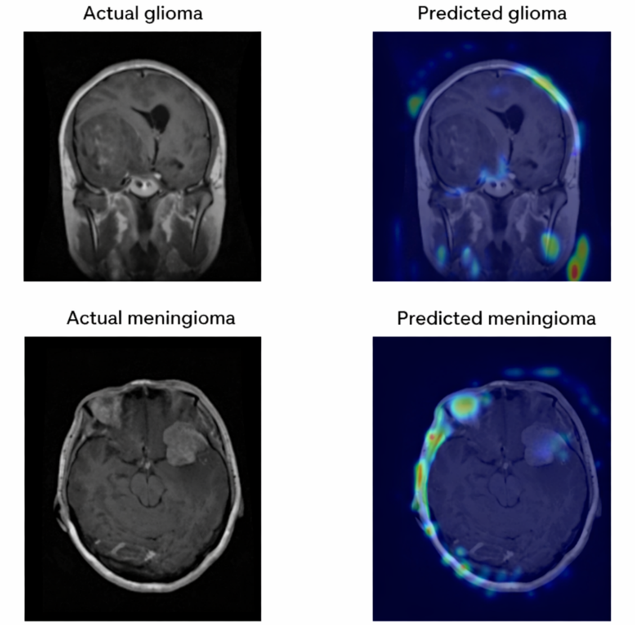
Background: Proper and interpretable brain tumor classification is essential in making a successful clinical decision in neurooncology. Automated approaches are potentially promising, but a lack of transparency in decision-making is usually an obstacle to clinical implementation. Objective: The proposed research developed and evaluated a convolutional neural network (CNN) model in the context of automatic brain tumor classification using magnetic resonance images (MRI) with a particular focus on a high-performing model and visualizing predictions using Gradient-weighted Class Activation Mapping (Grad-CAM). Methods: It utilized a dataset of 7,023 MRI scans as a sample, which was divided into glioma, meningioma, pituitary tumors, and no-tumor. Preprocessing of the data was done by normalizing and resizing, and stratifying into training, validation, and test subsets. The suggested CNN has been compared with the state-of-the-art transfer-learning architectures, such as VGG16, MobileNetV2, and DenseNet121. Results: The proposed CNN had the highest predictive accuracy of 94.75%, precision of 94.99%, recall of 94.75%, and an F1-score of 94.82%, and better than all the transfer-learning baselines. Moreover, Grad-CAM visualizations have always identified tumor-specific areas in the images, confirming the clinical plausibility of the model decisions. Conclusions: These results highlight the possibility of high-performance CNN-based classification used in conjunction with explainable AI to provide effective and high-quality diagnostic support that is accurate, dependable, and explainable by clinicians. The future research will explore the concept of multi-modal MRI integration, 3D architecture, and privacy-preserving deployment schemes in the context of real-life healthcare applications.
Downloads
References
D. N. Louis, A. Perry, P. Wesseling, D. J. Brat, I. A. Cree, D. Figarella-Branger, C. Hawkins, H. K. Ng, S. M. Pfister, G. Reifenberger, et al., “The 2021 WHO classification of tumors of the central nervous system: A summary,” Neuro-Oncology, vol. 23, no. 8, pp. 1231–1251, 2021.
CrossRef | Google Scholar | PubMed
Q. T. Ostrom, G. Cioffi, K. Waite, C. Kruchko, and J. S. Barnholtz-Sloan, “CBTRUS statistical report: Primary brain and other central nervous system tumors diagnosed in the United States in 2014–2018,” Neuro-Oncology, vol. 23, no. Supplement_3, pp. iii1–iii105, 2021.
CrossRef | Google Scholar | PubMed
Y. Chen, C.-B. Schönlieb, P. Lio, T. Leiner, P. L. Dragotti, G. Wang, D. Rueckert, D. Firmin, and G. Yang, “AI-based reconstruction for fast MRI: A systematic review and meta-analysis,” Proceedings of the IEEE, vol. 110, no. 2, pp. 224–245, 2022.
CrossRef | Google Scholar
J. Huang, Y. Fang, Y. Wu, H. Wu, Z. Gao, Y. Li, J. D. Ser, J. Xia, and G. Yang, “Swin transformer for fast MRI,” Neurocomputing, vol. 493, pp. 281–304, Jul. 2022.
CrossRef | Google Scholar
Y. Nan, J. D. Ser, S. Walsh, C. Schönlieb, M. Roberts, I. Selby, K. Howard, J. Owen, J. Neville, J. Guiot, et al., “Data harmonisation for information fusion in digital healthcare: A state-of-the-art systematic review, meta-analysis and future research directions,” Information Fusion, vol. 82, pp. 99–122, Jun. 2022.
CrossRef | Google Scholar | PubMed
B. H. Kann, A. Hosny, and H. J. Aerts, “Artificial intelligence for clinical oncology,” Cancer Cell, vol. 39, no. 7, pp. 916–927, 2021.
CrossRef | Google Scholar | PubMed
S. G. Anjara, A. Janik, A. Dunford-Stenger, K. Mc Kenzie, A. Collazo-Lorduy, M. Torrente, L. Costabello, and M. Provencio, “Examining explainable clinical decision support systems with think aloud protocols,” PLOS ONE, vol. 18, no. 9, Art no. e0291443, 2023.
CrossRef | Google Scholar | PubMed
M. A. Gómez-Guzmán, L. Jiménez-Beristaín, E. E. García-Guerrero, O. R. López-Bonilla, U. J. Tamayo-Perez, J. J. Esqueda-Elizondo, K. Palomino-Vizcaino, and E. Inzunza-González, “Classifying brain tumors on magnetic resonance imaging by using convolutional neural networks,” Electronics, vol. 12, no. 4, Art no. 955, 2023.
CrossRef | Google Scholar
R. A. Zeineldin, M. E. Karar, Z. Elshaer, J. Coburger, C. R. Wirtz, O. Burgert, and F. Mathis-Ullrich, “Explainability of deep neural networks for MRI analysis of brain tumors,” International Journal of Computer Assisted Radiology and Surgery, vol. 17, no. 9, pp. 1673–1683, 2022.
CrossRef | Google Scholar | PubMed
R. A. Zeineldin, M. E. Karar, Z. Elshaer, J. Coburger, C. R. Wirtz, O. Burgert, and F. Mathis-Ullrich, “Explainable hybrid vision transformers and convolutional network for multimodal glioma segmentation in brain MRI,” Scientific Reports, vol. 14, no. 1, Art no. 3713, 2024.
CrossRef | Google Scholar | PubMed
C. Rudin, C. Chen, Z. Chen, H. Huang, L. Semenova, and C. Zhong, “Interpretable machine learning: Fundamental principles and 10 grand challenges,” Statistics Surveys, vol. 16, pp. 1–85, 2022.
CrossRef | Google Scholar
E. Tjoa and C. Guan, “Quantifying explainability of saliency methods in deep neural networks with a synthetic dataset,” IEEE Transactions on Artificial Intelligence, vol. 4, no. 4, pp. 858–870, 2023.
CrossRef | Google Scholar
D. Bhati, F. Neha, and M. Amiruzzaman, “A survey on explainable artificial intelligence (XAI) techniques for visualizing deep learning models in medical imaging,” Journal of Imaging, vol. 10, no. 10, Art no. 239, 2024.
CrossRef | Google Scholar | PubMed
E. Tjoa, H. J. Khok, T. Chouhan, and C. Guan, “Enhancing the confidence of deep learning classifiers via interpretable saliency maps,” Neurocomputing, vol. 562, Art no. 126825, Dec. 2023.
CrossRef | Google Scholar
A. Raza, H. Ayub, J. A. Khan, I. Ahmad, A. S. Salama, Y. I. Daradkeh, D. Javeed, A. Ur Rehman, and H. Hamam, “A hybrid deep learning-based approach for brain tumor classification,” Electronics, vol. 11, no. 7, Art no. 1146, 2022.
CrossRef | Google Scholar
S. Akter, M. S. H. Talukder, S. K. Mondal, M. Aljaidi, R. B. Sulaiman, and A. A. Alshammari, “Brain tumor classification utilizing pixel distribution and spatial dependencies higher-order statistical measurements through explainable ML models,” Scientific Reports, vol. 14, no. 1, Art no. 25800, 2024.
CrossRef | Google Scholar | PubMed
A. A. Asiri, T. A. Soomro, A. A. Shah, G. Pogrebna, M. Irfan, and S. Alqahtani, “Optimized brain tumor detection: A dual-module approach for MRI image enhancement and tumor classification,” IEEE Access, vol. 12, pp. 42868–42887, 2024.
CrossRef | Google Scholar
O. Özkaraca, O. İ. Bağrıaçık, H. Gürüler, F. Khan, J. Hussain, J. Khan, and U. E. Laila, “Multiple brain tumor classification with dense CNN architecture using brain MRI images,” Life, vol. 13, no. 2, Art no. 349, 2023.
CrossRef | Google Scholar | PubMed
S. Hossain, A. Chakrabarty, T. R. Gadekallu, M. Alazab, and M. J. Piran, “Vision transformers, ensemble model, and transfer learning leveraging explainable AI for brain tumor detection and classification,” IEEE Journal of Biomedical and Health Informatics, vol. 28, no. 3, pp. 1261–1272, 2024.
CrossRef | Google Scholar | PubMed
S. Iftikhar, N. Anjum, A. B. Siddiqui, M. Ur Rehman, and N. Ramzan, “Explainable CNN for brain tumor detection and classification through XAI based key features identification,” Brain Informatics, vol. 12, no. 1, Art no. 10, 2025.
CrossRef | Google Scholar | PubMed
P. Narayankar and V. P. Baligar, “Explainability of brain tumor classification based on region,” in 2024 International Conference on Emerging Technologies in Computer Science for Interdisciplinary Applications (ICETCS), IEEE, Apr. 2024, pp. 1–6.
CrossRef | Google Scholar
S. Kumar, S. Choudhary, A. Jain, K. Singh, A. Ahmadian, and M. Y. Bajuri, “Brain tumor classification using deep neural network and transfer learning,” Brain Topography, vol. 36, no. 3, pp. 305–318, 2023.
CrossRef | Google Scholar | PubMed
M. I. Nazir, A. Akter, M. A. H. Wadud, and M. A. Uddin, “Utilizing customized CNN for brain tumor prediction with explainable AI,” Heliyon, vol. 10, no. 20, Art no. e38997, 2024.
CrossRef | Google Scholar | PubMed
K. M. Hosny, M. A. Mohammed, R. A. Salama, and A. M. Elshewey, “Explainable ensemble deep learning-based model for brain tumor detection and classification,” Neural Computing and Applications, vol. 37, no. 3, pp. 1289–1306, 2024.
CrossRef | Google Scholar
P. Roy, F. M. S. Srijon, and P. Bhowmik, “An explainable ensemble approach for advanced brain tumor classification applying Dual-GAN mechanism and feature extraction techniques over highly imbalanced data,” PLOS ONE, vol. 19, no. 9, Art no. e0310748, 2024.
CrossRef | Google Scholar | PubMed
S. Mandloi, M. Zuber, and R. K. Gupta, “An explainable brain tumor detection and classification model using deep learning and layer-wise relevance propagation,” Multimedia Tools and Applications, vol. 83, no. 11, pp. 33753–33783, 2023.
CrossRef | Google Scholar
R. Singh, S. Gupta, A. O. Ibrahim, L. A. Gabralla, S. Bharany, A. U. Rehman, and S. Hussen, “Advanced dynamic ensemble framework with explainability driven insights for precision brain tumor classification across datasets,” Scientific Reports, vol. 15, no. 1, Art no. 29090, 2025.
CrossRef | Google Scholar | PubMed
R. Haque, M. M. Hassan, A. K. Bairagi, and S. M. S. Islam, “NeuroNet19: An explainable deep neural network model for the classification of brain tumors using magnetic resonance imaging data,” Scientific Reports, vol. 14, no. 1, Art no. 1524, 2024.
CrossRef | Google Scholar | PubMed
M. M. Ahmed, M. M. Hossain, M. R. Islam, M. S. Ali, A. A. N. Nafi, M. F. Ahmed, K. M. Ahmed, M. S. Miah, M. M. Rahman, M. Niu, et al., “Brain tumor detection and classification in MRI using hybrid ViT and GRU model with explainable AI in Southern Bangladesh,” Scientific Reports, vol. 14, no. 1, Art no. 22797, 2024.
CrossRef | Google Scholar | PubMed
M. M. Islam, M. A. Talukder, M. A. Uddin, A. Akhter, and M. Khalid, “BrainNet: Precision brain tumor classification with optimized EfficientNet architecture,” International Journal of Intelligent Systems, vol. 2024, no. 1, Art no. 3583612, 2024.
CrossRef | Google Scholar
M. Nahiduzzaman, L. F. Abdulrazak, H. B. Kibria, A. Khandakar, M. A. Ayari, M. F. Ahamed, M. Ahsan, J. Haider, M. A. Moni, and M. Kowalski, “A hybrid explainable model based on advanced machine learning and deep learning models for classifying brain tumors using MRI images,” Scientific Reports, vol. 15, no. 1, Art no. 1649, 2025.
CrossRef | Google Scholar | PubMed
Q. Mastoi, S. Latif, S. Brohi, J. Ahmad, A. Alqhatani, M. S. Alshehri, A. Al Mazroa, and R. Ullah, “Explainable AI in medical imaging: An interpretable and collaborative federated learning model for brain tumor classification,” Frontiers in Oncology, vol. 15, Feb. 2025.
CrossRef | Google Scholar | PubMed
L. Sánchez-Moreno, A. Perez-Peña, L. Duran-Lopez, and J. P. Dominguez-Morales, “Ensemble-based convolutional neural networks for brain tumor classification in MRI: Enhancing accuracy and interpretability using explainable AI,” Computers in Biology and Medicine, vol. 195, Art no. 110555, Sep. 2025.
CrossRef | Google Scholar | PubMed
Downloads
Key Dates
Received
Revised
Accepted
Published
Data Availability Statement
The dataset used and analyzed during the current study, “Brain Tumor MRI Dataset”, is publicly available on Kaggle at: (https://www.kaggle.com/datasets/masoudnickparvar/brain-tumor-mri-dataset). Additional processed data are available from the corresponding author upon reasonable request.
Issue
Section
License
Copyright (c) 2026 Rasha Jamal Hindi, Fuat Türk

This work is licensed under a Creative Commons Attribution 4.0 International License.
(Starting May 5, 2024) Authors retain copyright and grant the journal right of first publication with the work simultaneously licensed under a Creative Commons Attribution (CC-BY) 4.0 License that allows others to share the work with an acknowledgement of the work’s authorship and initial publication in this journal.
How to Cite