Estimation of the Optimum Etching Time and Etching Parameters for CR-39 Nuclear Tracks Detector by Applying Plasma and Chemical Etching Techniques
DOI:
https://doi.org/10.23851/mjs.v36i3.1699Keywords:
CR-39, Nuclear detectors, DBD plasma, Wet etching, Dry etching, Plasma interaction, Etching parametersAbstract
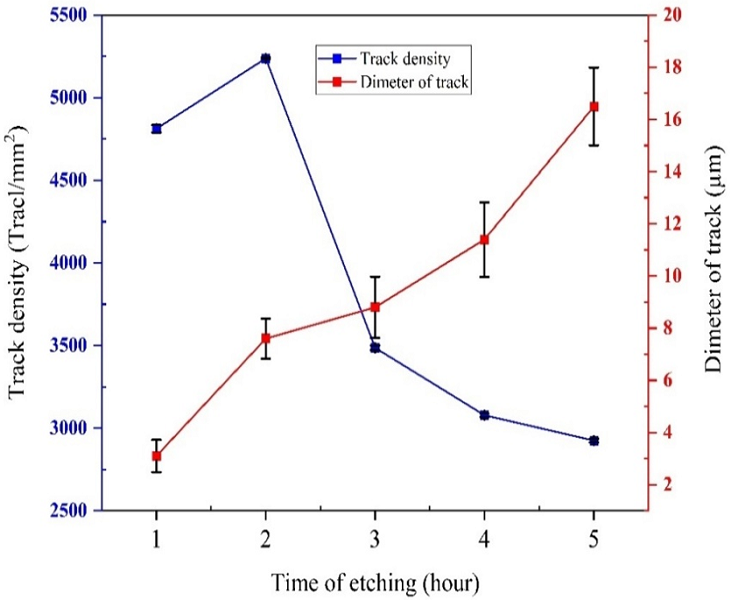
Background: CR-39 nuclear track detectors are widely used in various fields, including science, technology, astronomy, and environmental preservation, to detect and register heavy ions, neutrons, and alpha particles. Objective: This study aims to determine the optimal etching duration for CR-39 nuclear track detectors by comparing etching methods: The wet etching (using a water bath) and the dry etching technique (using dielectric barrier discharge (DBD) plasma). Methods: The traditional etching method involved immersing CR-39 detectors in a sodium hydroxide (NaOH) solution at 70 °C for varying durations. The dry etching method employed employs a non-thermal DBD plasma system to etch solid-state nuclear track detectors (SSNTDs) without the use of chemical solutions. Results: Photomicrographs revealed that tracks from chemical etching became clearly visible after 1 hour and developed at 5 hours. In contrast, the dry etching technique was significantly faster; tracks began to appear after just 1 minute of DBD plasma etching and were fully developed at 5 minutes. The optimum track density for DBD plasma was 20340±56 tracks/mm2 at 3 minutes, whereas the traditional water bath method achieved an optimum track density of 5238.0±5.7 tracks/mm2 at 2 hours. The shorter etching duration in the dry method likely facilitates the emergence of latent tracks without overlap. Conclusions: The bulk etch rate (VB) for CR-39 detectors using the dry DBD plasma etching technique was faster compared to the traditional chemical etching method. This demonstrates the efficacy of the dry etching process in significantly reducing etching time required for etching SSNDs.
Downloads
References
N. Frane and A. Bitterman, Radiation Safety and Protection. StatPearls Publishing, Treasure Island (FL), 2025.
Google Scholar | Link
A. Khan, S. Al Qahtani, W. AL-Maqbool, T. I. Al-Naggar, M. Alhamami, and A. M. Abdalla, “Efficient and fast detection of alpha particles using CR-39 detector,” Radiation Physics and Chemistry, vol. 213, p. 111237, Dec. 2023.
CrossRef | Google Scholar
K. A. Aadim, K. A. Ahmed, and R. S. Mohammed, “Diagnostic analysis of Cu and CuZn plasma produced by Nd: YAG nanosecond laser at 1064 nm,” AIP Conference Proceedings, vol. 2402, Art no. 080018, 2021.
CrossRef | Google Scholar
N. Dwaikat, “Charge particle spectroscopy: A solid-state nuclear track detector (SSNTD)-based spectrometer,” Arabian Journal for Science and Engineering, vol. 49, no. 1, pp. 1237–1243, 2023.
CrossRef | Google Scholar
M. El-Deep, F. Abdel-Wahab, N. El-Faramawy, and H. Abdelmaksoud, “Influence of irradiation of CR-39 with α-particles on the optical dispersion parameters: Role of chemical etching to develop nuclear tracks,” Radiation Physics and Chemistry, vol. 193, Art no. 109965, Apr. 2022.
CrossRef | Google Scholar
M. Shoeib, M. A. El-Apasery, D. A. Ahmed, and A. Abd-Elraheem, “Determination of Radium concentration and Radon Exhalation Rates Using CR-39 Detector for Different Geopolymer Cement Samples Containing Industrial Wastes,” Radiation Physics and Chemistry, vol. 222, Art no. 111790, Sep. 2024.
CrossRef | Google Scholar
M. Adelikhah, A. Shahrokhi, M. Imani, S. Chalupnik, and T. Kovács, “Radiological assessment of indoor radon and thoron concentrations and indoor radon map of dwellings in Mashhad, Iran,” International Journal of Environmental Research and Public Health, vol. 18, no. 1, Art no. 141, 2020.
CrossRef | Google Scholar | PubMed
N. F. Kadhim, A. A. Ridha, M. D. Salim, M. Hanfi, and M. Y. Mostafa, “Development of alpha tracks measurement with thermal oven as an etching technique for SSNTDs,” Materials Today: Proceedings, vol. 44, pp. 2903–2908, 2021.
CrossRef | Google Scholar
R. S. Mohammed, R. S. Ahmed, and R. O. Abdaljalil, “Estimation of radon activity concentration in Abu Al-Khaseb and Ad Dayer soil in southern Iraq using CR-39 detector,” Environmental Earth Sciences, vol. 80, no. 5, Art no. 198, 2021.
CrossRef | Google Scholar
N. Alene Assefa, “Analysis of 226Ra content and 222Rn exhalation rates in soil samples from Wukro, Tigray, using SSNTDs,” F1000Research, vol. 14, no. 289, Art no. 289, 2025.
CrossRef | Google Scholar | PubMed
K. C. C. Pires, M. Assunção, M. A. Rana, S. Guedes, R. Künzel, and N. M. Trindade, “Etching and optical properties of 1–2 MeV alpha particles irradiated CR-39 radiation detectors,” Nuclear Instruments and Methods in Physics Research Section A: Accelerators, Spectrometers, Detectors and Associated Equipment, vol. 1041, Art no. 167370, Oct. 2022.
CrossRef | Google Scholar
D. Nikezic and K. Yu, “Formation and growth of tracks in nuclear track materials,” Materials Science and Engineering: R: Reports, vol. 46, no. 3–5, pp. 51–123, 2004.
CrossRef | Google Scholar
M. A. Rana, “CR-39 nuclear track detector: An experimental guide,” Nuclear Instruments and Methods in Physics Research Section A: Accelerators, Spectrometers, Detectors and Associated Equipment, vol. 910, pp. 121–126, Dec. 2018.
CrossRef | Google Scholar
N. Stevanovic, V. Markovic, M. Milosevic, A. Djurdjevic, J. Stajic, B. Milenkovic, and D. Nikezic, “Correlations between track parameters in a solid-state nuclear track detector and its diffraction pattern,” Radiation Physics and Chemistry, vol. 193, Art no. 109986, Apr. 2022.
CrossRef | Google Scholar
P. Henderson, “(R. L.) Fleischer, (P. B.) Price, and (R. M.) Walker. Nuclear Tracks in Solids: Principles and Applications. Berkeley and London (Univ. California Press), 1975. xxii+605 pp., 205 figs., I pl. Price,” Mineralogical Magazine, vol. 42, no. 322, pp. 306–307, 1978.
CrossRef
A. Pandey, P. Kalsi, and R. Iyer, “Effects of high intensity ultrasound in chemical etching of particle tracks in solid state nuclear track detectors,” Nuclear Instruments and Methods in Physics Research Section B: Beam Interactions with Materials and Atoms, vol. 134, no. 3–4, pp. 393–399, 1998.
CrossRef | Google Scholar
N. M. Brown and Z. H. Liu, “The etching of natural alpha-recoil tracks in mica with an argon RF-plasma discharge and their imaging via atomic force microscopy,” Applied Surface Science, vol. 93, no. 2, pp. 89–100, 1996.
CrossRef | Google Scholar
Y. Todorova, E. Benova, P. Marinova, I. Yotinov, T. Bogdanov, and Y. Topalova, “Non-Thermal atmospheric plasma for microbial decontamination and removal of hazardous chemicals: An overview in the circular economy context with data for test applications of microwave plasma torch,” Processes, vol. 10, no. 3, Art no. 554, 2022.
CrossRef | Google Scholar
F. do Nascimento, S. Moshkalev, and M. Machida, “Changes in properties of dielectric barrier discharge plasma jets for different gases and for insulating and conducting transfer plates,” Brazilian Journal of Physics, vol. 47, no. 3, pp. 278–287, 2017.
CrossRef | Google Scholar
J. He, X. Wen, L. Wu, H. Chen, J. Hu, and X. Hou, “Dielectric barrier discharge plasma for nanomaterials: Fabrication, modification and analytical applications,” TrAC Trends in Analytical Chemistry, vol. 156, Art no. 116715, Nov. 2022.
CrossRef | Google Scholar
R. S. Mohammed and M. F. Al -Marjani, “DBD plasma as a practical approach to sterilization of dental instruments,” Physica Scripta, vol. 99, no. 4, Art no. 045601, 2024.
CrossRef | Google Scholar
D. Astanei, R. Burlica, D.-E. Cretu, M. Olariu, I. Stoica, and O. Beniuga, “Treatment of polymeric films used for printed electronic circuits using ambient air DBD non-thermal plasma,” Materials, vol. 15, no. 5, Art no. 1919, 2022.
CrossRef | Google Scholar | PubMed
C. Sabbarese, F. Ambrosino, and V. Roca, “Analysis by scanner of tracks produced by radon alpha particles in CR-39 detectors,” Radiation Protection Dosimetry, vol. 191, no. 2, pp. 154–159, 2020.
CrossRef | Google Scholar | PubMed
M. D. Salim, A. A. Ridha, N. F. Kadhim, and A. E. Taher, “Effects of changing the exposure time of CR-39 detector to alpha particles on etching conditions,” Journal of Radiation and Nuclear Applications, vol. 5, no. 2, pp. 119–125, 2020.
CrossRef | Google Scholar
P. Cools, L. Astoreca, P. S. Esbah Tabaei, M. Thukkaram, H. De Smet, R. Morent, and N. De Geyter, “Surface treatment of polymers by plasma,” Surface Modification of Polymers, pp. 31–65, Nov. 2019.
CrossRef | Google Scholar
P. Dimitrakellis, F. Faubert, M. Wartel, E. Gogolides, and S. Pellerin, “Plasma surface modification of epoxy polymer in air DBD and gliding arc,” Processes, vol. 10, no. 1, Art no. 104, 2022.
CrossRef | Google Scholar
Reema, R. R. Khanikar, H. Bailung, and K. Sankaranarayanan, “Review of the cold atmospheric plasma technology application in food, disinfection, and textiles: A way forward for achieving circular economy,” Frontiers in Physics, vol. 10, Art no. 942952, Sep. 2022.
CrossRef | Google Scholar
S. A. Durrani and R. K. Bull, Solid state nuclear track detection: Principles, methods and applications. Elsevier BV, 1987.
CrossRef | Google Scholar
S. Tripathy, R. Kolekar, C. Sunil, P. Sarkar, K. Dwivedi, and D. Sharma, “Microwave-induced chemical etching (MCE): A fast etching technique for the solid polymeric track detectors (SPTD),” Nuclear Instruments and Methods in Physics Research Section A: Accelerators, Spectrometers, Detectors and Associated Equipment, vol. 612, no. 2, pp. 421–426, 2010.
CrossRef | Google Scholar
S. A. Durrani and R. Ilic, Radon measurements by etched track detectors: Applications in radiation protection, earth sciences and the environment. World Scientific, Jun. 1997.
CrossRef | Google Scholar
N. F. Kadhim and L. A. Jebur, “Investigation of the favorable etching time of CN-85 nuclear track detector,” Applied Radiation and Isotopes, vol. 135, pp. 28–32, May 2018.
CrossRef | Google Scholar | PubMed
M. D. Salim, A. A. Marzaali, H. Khalaf, and M. Mostafa, “Comparison between etching techniques for solid-state nuclear track detector (CN-85) to develop alpha tracks,” Radiation Physics and Chemistry, vol. 213, Art no. 111224, Dec. 2023.
CrossRef | Google Scholar
V. Barone, S. Alessandrini, M. Biczysko, J. R. Cheeseman, D. C. Clary, A. B. McCoy, R. J. DiRisio, F. Neese, M. Melosso, and C. Puzzarini, “Computational molecular spectroscopy,” Nature Reviews Methods Primers, vol. 1, no. 1, Art no. 38, 2021.
CrossRef | Google Scholar
A. Ionascut-Nedelcescu, C. Carlone, U. Kogelschatz, D. V. Gravelle, and M. I. Boulos, “Calculation of the gas temperature in a throughflow atmospheric pressure dielectric barrier discharge torch by spectral line shape analysis,” Journal of Applied Physics, vol. 103, no. 6, Art no. 063305, 2008.
CrossRef | Google Scholar
K. A. Ahmed, K. A. Aadim, and R. S. Mohammed, “Investigation the energy influence and excitation wavelength on spectral characteristics of laser induced MgZn plasma,” AIP Conference Proceedings, vol. 2402, Art no. 080004, 2021.
CrossRef | Google Scholar
R. S. Ahmed and R. S. Mohammed, “Assessment of uranium concentration in blood of Iraqi females diagnosed with breast cancer,” Radiation and Environmental Biophysics, vol. 60, no. 1, pp. 193–201, 2020.
CrossRef | Google Scholar | PubMed
J. F. Ziegler, M. Ziegler, and J. Biersack, “SRIM – The stopping and range of ions in matter (2010),” Nuclear Instruments and Methods in Physics Research Section B: Beam Interactions with Materials and Atoms, vol. 268, no. 11–12, pp. 1818–1823, 2010.
CrossRef | Google Scholar
A. M. Abdalla, T. I. Al-Naggar, R. H. Alhandhal, and H. B. Albargi, “Registration of alpha particles using CR-39 nuclear detector,” Nuclear Instruments and Methods in Physics Research Section A: Accelerators, Spectrometers, Detectors and Associated Equipment, vol. 1042, Art no. 167419, Nov. 2022.
CrossRef | Google Scholar
H. Alameri, Y. Abou-Ali, M. Obeid, and R. Shweikani, “Estimation of alpha exposure on CR-39 detector using a UV-VIS spectrophotometer,” Applied Radiation and Isotopes, vol. 209, Art no. 111331, Jul. 2024.
CrossRef | Google Scholar | PubMed
A. M. Dahham and N. F. Kadhim, “Determination of the energy of the incident alpha particle by the diameter of the track registered in CR-39 detector,” in AIP Conference Proceedings, vol. 2386, Art no. 080041, 2022.
CrossRef | Google Scholar
K. N. Yu, F. M. F. Ng, J. P. Y. Ho, C. W. Y. Yip, and D. Nikezic, “Measurement of parameters of tracks in CR-39 detector from replicas,” Radiation Protection Dosimetry, vol. 111, no. 1, pp. 93–96, 2004.
CrossRef | Google Scholar | PubMed
A. A. Azooz and M. A. Al-Jubbori, “Interrelated temperature dependence of bulk etch rate and track length saturation time in CR-39 detector,” Nuclear Instruments and Methods in Physics Research Section B: Beam Interactions with Materials and Atoms, vol. 316, pp. 171–175, Dec. 2013.
CrossRef | Google Scholar
G. Sahoo, S. Tripathy, and T. Bandyopadhyay, “Optimization of microwave-induced chemical etching for rapid development of neutron-induced recoil tracks in CR-39 detectors,” Nuclear Instruments and Methods in Physics Research Section A: Accelerators, Spectrometers, Detectors and Associated Equipment, vol. 739, pp. 83–88, Mar. 2014.
CrossRef | Google Scholar
Y. Rammah, O. Ashraf, A. Abdalla, M. Eisa, A. Ashry, and T. Tsuruta, “Fast detection of alpha particles in DAM-ADC nuclear track detectors,” Radiation Physics and Chemistry, vol. 107, pp. 183–188, Feb. 2015.
CrossRef | Google Scholar
P. Rumbach, D. M. Bartels, R. M. Sankaran, and D. B. Go, “The effect of air on solvated electron chemistry at a plasma/liquid interface,” Journal of Physics D: Applied Physics, vol. 48, no. 42, Art no. 424001, 2015.
CrossRef | Google Scholar
Downloads
Key Dates
Received
Revised
Accepted
Published
Data Availability Statement
Data are available from the authors upon reasonable request
Issue
Section
License
Copyright (c) 2025 Abdulkader Makki Dahham, Jamoliddin Razzokov, Eldor Karimbaev, Raghad S. Mohammed

This work is licensed under a Creative Commons Attribution 4.0 International License.
(Starting May 5, 2024) Authors retain copyright and grant the journal right of first publication with the work simultaneously licensed under a Creative Commons Attribution (CC-BY) 4.0 License that allows others to share the work with an acknowledgement of the work’s authorship and initial publication in this journal.
How to Cite