Comparative Analysis of IL-18 Expression Across Therapeutic Modalities in Multiple Sclerosis
DOI:
https://doi.org/10.23851/mjs.v37i3.1881Keywords:
Multiple sclerosis, Interleukin-18, Cytokines, Disease-modifying therapy, NeuroinflammationAbstract
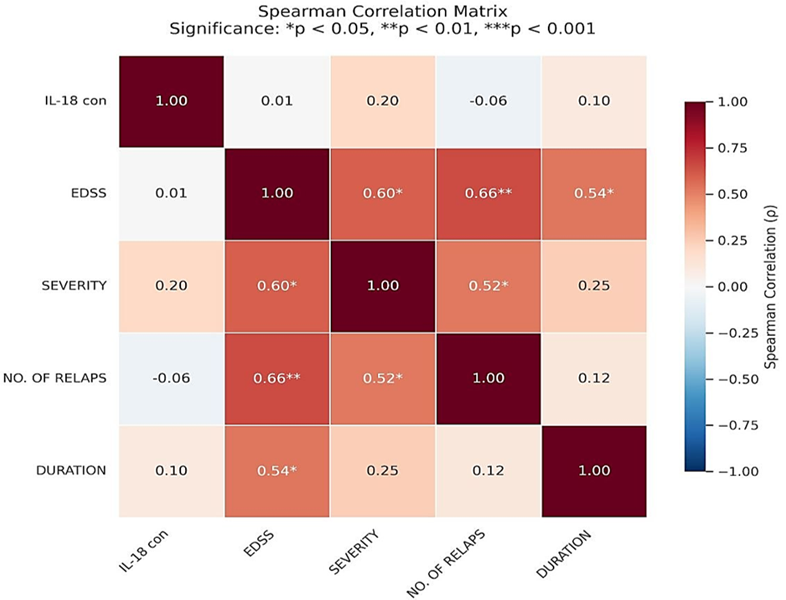
Background: Multiple sclerosis represents a chronic autoimmune pathology associated with immune-related demyelination and neuro inflammation in the central nervous system. Recently, interleukin-18 appears to represent one of the major cytokines among other inflammatory mediators, responsible for innate and adaptive immunity cross-talk and involvement in disease development. Its behavior in diverse therapeutic regimes remains not sufficiently studied. Objective: The aim of this work was to evaluate seruminterleukin-18 concentration in multiple sclerosis patients under different treatments and assess its diagnostic value in terms of treatment efficacy and pathogenesis. All the subjects involved totaled 180, including 16 untreated patients,20 negative control groups, and patients under 60 on first 48, second 36, and third-line therapies. Methods: Measurement of serum interleukin-18 concentration was performed using the enzyme-linked immunosorbent assay method. Cytokine levels were correlated with clinical variables, such as disability score, disease duration, and relapse frequency. Data analysis was done using the software package SPSS. There were certain differences found in interleukin-18levels in distinct groups, suggesting its biomarker role as a marker of disease dynamics and therapy efficiency. To further explore clinical implications of our findings, further studies are required. Results: Significant differences in interleukin-18 levels were demonstrated among distinct groups. Untreated patients had moderate elevations, and healthy controls had the lowest levels. First-line therapies showed heterogeneous effects; some treatments were associated with lower cytokine levels and others with higher expression. The highest levels of interleukin-18 were found in patients receiving second-line treatments, followed by third-line treatments. Cytokine levels increased progressively with escalation of therapy and longer duration of disease. Correlation analysis revealed that disability scores (EDSS) was significantly associated with disease duration, relapse frequency, and disease severity, but not with serum IL-18 levels. Receiver operation characteristic analysis indicated moderate diagnostic ability. Conclusions: In summary, interleukin-18 indicates both the inflammatory burden and the immune modulation induced by therapy in multiple sclerosis. While it is not appropriate as an independent diagnostic marker, it may function as an adjunct biomarker for assessing disease activity and immunological variations during treatment regimens
Downloads
References
J. Derbyshire and G. Kamara, "Multiple sclerosis management: Therapies and future perspectives," British Journal of Neuroscience Nursing, vol. 21, no. Sup4, pp. S14–S19, 2025. DOI: https://doi.org/10.12968/bjnn.2025.0056
M. P. McGinley, C. H. Goldschmidt, and A. D. Rae-Grant, "Diagnosis and treatment of multiple sclerosis: A review," JAMA, vol. 325, no. 8, pp. 765–779, 2021. DOI: https://doi.org/10.1001/jama.2020.26858
J. Tan, C. H. Marck, P. Martin-Lynch, P. Skeffington, D. Walker, L. Gibbs, and Y. C. Learmonth, "Disaster preparation for people with multiple sclerosis: A scoping review of resources," International Journal of MS Care, vol. 27, pp. 186–194, Jul. 2025. DOI: https://doi.org/10.7224/1537-2073.2024-066
S. L. Hauser and B. A. Cree, "Treatment of multiple sclerosis: A review," The American Journal of Medicine, vol. 133, no. 12, pp. 1380–1390.e2, 2020. DOI: https://doi.org/10.1016/j.amjmed.2020.05.049
V. Fuh-Ngwa, J. C. Charlesworth, Y. Zhou, I. van der Mei, P. E. Melton, S. A. Broadley, A.-L. Ponsonby, S. Simpson-Yap, J. Lechner-Scott, and B. V. Taylor, "The association between disability progression, relapses, and treatment in early relapse onset MS: An observational, multi-centre, longitudinal cohort study," Scientific Reports, vol. 13, no. 1, Art no. 11584, 2023. DOI: https://doi.org/10.1038/s41598-023-38415-z
Ø. Torkildsen, K.-M. Myhr, and L. Bø, "Disease‐modifying treatments for multiple sclerosis – a review of approved medications," European Journal of Neurology, vol. 23, no. S1, pp. 18–27, 2015. DOI: https://doi.org/10.1111/ene.12883
H. Mado, A. Stasiniewicz, M. Adamczyk-Sowa, and P. Sowa, "Selected interleukins relevant to multiple sclerosis: New directions, potential targets and therapeutic perspectives," International Journal of Molecular Sciences, vol. 25, no. 20, Art no. 10931, 2024. DOI: https://doi.org/10.3390/ijms252010931
W. Xu, Y. Huang, and R. Zhou, "NLRP3 inflammasome in neuroinflammation and central nervous system diseases," Cellular & Molecular Immunology, vol. 22, no. 4, pp. 341–355, 2025. DOI: https://doi.org/10.1038/s41423-025-01275-w
D. Novick, "IL-18 and IL-18BP: A unique dyad in health and disease," International Journal of Molecular Sciences, vol. 25, no. 24, Art no. 13505, 2024. DOI: https://doi.org/10.3390/ijms252413505
S. A. Ihim, S. D. Abubakar, Z. Zian, T. Sasaki, M. Saffarioun, S. Maleknia, and G. Azizi, "Interleukin-18 cytokine in immunity, inflammation, and autoimmunity: biological role in induction, regulation, and treatment," Frontiers in Immunology, vol. 13, Art no. 919973, Aug. 2022. DOI: https://doi.org/10.3389/fimmu.2022.919973
F. Alsahebfosoul, H. Jahanbani-Ardakani, M. Etemadifar, and S.-H. Abtahi, "Interleukin 18 polymorphisms and its serum level in patients with multiple sclerosis," Annals of Indian Academy of Neurology, vol. 22, no. 4, pp. 474–476, 2019. DOI: https://doi.org/10.4103/aian.AIAN_515_18
X. Jiang, H. Zhang, Y. Liu, B. Sun, and G. Mu, "Global perspectives on the contribution of B cells to multiple sclerosis: An in-depth examination and evaluation," Frontiers in Immunology, vol. 15, Art no. 1442694, Nov. 2024. DOI: https://doi.org/10.3389/fimmu.2024.1442694
G. Edan and E. Le Page, "Escalation versus induction/high-efficacy treatment strategies for relapsing multiple sclerosis: Which is best for patients?" Drugs, vol. 83, no. 15, pp. 1351–1363, 2023. DOI: https://doi.org/10.1007/s40265-023-01942-0
K. Selmaj, H.-P. Hartung, M. P. Mycko, I. Selmaj, and A. H. Cross, "MS treatment de-escalation: Review and commentary," Journal of Neurology, vol. 271, no. 10, pp. 6426–6438, 2024. DOI: https://doi.org/10.1007/s00415-024-12584-x
A. He, B. Merkel, J. W. L. Brown, L. Zhovits Ryerson, I. Kister, C. B. Malpas, S. Sharmin, D. Horakova, E. Kubala Havrdova, T. Spelman, et al., "Timing of high-efficacy therapy for multiple sclerosis: A retrospective observational cohort study," The Lancet Neurology, vol. 19, no. 4, pp. 307–316, 2020. DOI: https://doi.org/10.1016/S1474-4422(20)30067-3
J. Guo, T. Olsson, L. Alfredsson, and A. K. Hedström, "Disability progression in multiple sclerosis: A latent class analysis of predictors," Journal of Neurology, vol. 273, no. 2, Art no. 157, 2026. DOI: https://doi.org/10.1007/s00415-026-13704-5
C. A. Dendrou, L. Fugger, and M. A. Friese, "Immunopathology of multiple sclerosis," Nature Reviews Immunology, vol. 15, no. 9, pp. 545–558, 2015. DOI: https://doi.org/10.1038/nri3871
C. D’Angelo, M. Reale, E. Costantini, M. Di Nicola, I. Porfilio, C. de Andrés, L. Fernández-Paredes, S. Sánchez-Ramón, and L. Pasquali, "Profiling of canonical and non-traditional cytokine levels in interferon-β-treated relapsing–remitting-multiple sclerosis patients," Frontiers in Immunology, vol. 9, Art no. 1240, Jun. 2018. DOI: https://doi.org/10.3389/fimmu.2018.01240
B. Grigorov, A. Trenova, A. Grigorova, and S. a. Stanilova, "IL-18 promoter polymorphism and IL-18 serum levels in association with relapsing-remitting multiple sclerosis," Journal of IMAB - Annual Proceeding (Scientific Papers), vol. 26, no. 4, pp. 3475–3480, 2020. DOI: https://doi.org/10.5272/jimab.2020264.3475
E. Mohsen, H. Haffez, S. Ahmed, T. S. El-Mahdy, and S. Hamed, "Association of cytokine levels with treatment duration and patient family history in Egyptian multiple sclerosis patients," Scientific Reports, vol. 16, no. 1, Art no. 7951, 2026. DOI: https://doi.org/10.1038/s41598-026-38500-z
G. P. Christophi, J. A. Christophi, R. C. Gruber, C. Mihai, L. J. Mejico, P. T. Massa, and B. Jubelt, "Quantitative differences in the immunomodulatory effects of Rebif and Avonex in IFN-β1a treated multiple sclerosis patients," Journal of the Neurological Sciences, vol. 307, no. 1-2, pp. 41–45, 2011. DOI: https://doi.org/10.1016/j.jns.2011.05.024
N. Madjdinasab, S. E. Mohammadiany Nejad, S. Tarahomi, F. Sadr, and M. Bahadoram, "Comparison of the effects of Cinnovex, Rebif and Betaferon on a expanded disability status scale of patients with multiple sclerosis," Jentashapir Journal of Cellular and Molecular Biology, vol. 6, no. 3, Art no. e29201, 2015. DOI: https://doi.org/10.5812/jjhr.6(3)2015.29201
G. Abbadessa, E. Maida, S. Bonavita, and L. Lavorgna, "First the B cells fall, then the T cells follow: Temporal immunological shift with ocrelizumab in multiple sclerosis," Journal of Neurology, vol. 272, no. 9, Art no. 582, 2025. DOI: https://doi.org/10.1007/s00415-025-13297-5
B. Jevtić, N. Momcilovic, G. Stegnjaić, M. Lazarević, S. Stanisavljević, O. Tamas, N. Veselinovic, M. Budimkic, S. Mesaros, Đ. Miljković, et al., "Assessing peripheral blood biomarkers and predictive patterns in multiple sclerosis using cytokines and immune gene expression profiles in ocrelizumab-treated patients: Tracking tumor necrosis factor," International Journal of Molecular Sciences, vol. 26, no. 23, Art no. 11295, 2025. DOI: https://doi.org/10.3390/ijms262311295
J. A. Gracie, S. E. Robertson, and I. B. McInnes, "Interleukin-18," Journal of Leukocyte Biology, vol. 73, no. 2, pp. 213–224, 2003. DOI: https://doi.org/10.1189/jlb.0602313
C. A. Dinarello, "Overview of the IL-1 family in innate inflammation and acquired immunity," Immunological Reviews, vol. 281, no. 1, pp. 8–27, 2017. DOI: https://doi.org/10.1111/imr.12621
Downloads
Key Dates
Received
Revised
Accepted
Published
Data Availability Statement
The data that support the findings of this study are available from the corresponding authors upon reasonable request.
Issue
Section
License
Copyright (c) 2026 Zahraa Mazin Zyara, Alia Essam Mahmood, Gheyath Abd Ali Shallal

This work is licensed under a Creative Commons Attribution 4.0 International License.
(Starting May 5, 2024) Authors retain copyright and grant the journal right of first publication with the work simultaneously licensed under a Creative Commons Attribution (CC-BY) 4.0 License that allows others to share the work with an acknowledgement of the work’s authorship and initial publication in this journal.
How to Cite