The Detrimental Effect of Titanium Dioxide Nanoparticles on Liver, Kidney and Lipid Profile of Albino Mice Intraperitoneal Exposure
DOI:
https://doi.org/10.23851/mjs.v36i4.1742Keywords:
Titanium dioxide nanoparticles, Nanotoxicology, Biochemical markers, Liver and kidney functions, Lipid profile alterationAbstract
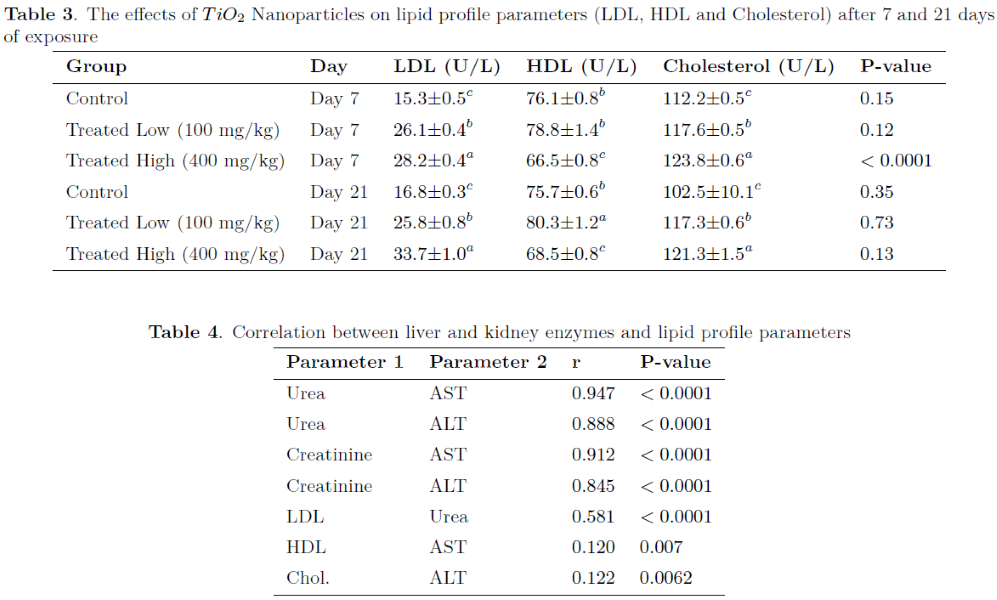
Background: Titanium dioxide nanoparticles (TiO2 NPs) have widespread use in industrial and biological fields owing to their distinctive physicochemical characteristics. Nonetheless, their growing prevalence raises concerns over their possible toxicological impacts, especially on the functionality of essential organs. Objective: The present work examines the subacute toxicity of TiO2 nanoparticles on hepatic and renal function and modifications in the lipid profile in a mouse model. Methods: Forty-eight adult female albino mice were divided randomly into three groups (n=16 each). Two groups were treated intraperitoneally with TiO2 NPs at 100 mg/kg and 400 mg/kg, respectively, while the control group was treated with distilled water. The animals were sacrificed after 7 and 21 days of treatment. Serum levels of urea, creatinine, aspartate aminotransferase (AST), alanine aminotransferase (ALT), and lipid profile parameters (cholesterol, HDL, LDL) were estimated. Results: Both treated groups showed significant rises in urea, creatinine, AST, and ALT levels (p<0.0001) compared to the control. These were more pronounced at higher concentrations and longer exposure durations. Cholesterol level fell after 21 days, with significant drops in HDL and rises in LDL (p<0.0001). Conclusions: TiO2 NPs induce dose- and time-related alteration of liver and kidney function, and lipid metabolism in mice. These findings highlight that further toxicological research on nanoparticle exposure in environmental and biomedical applications is needed.
Downloads
References
T. A. Saleh, “Nanomaterials: Classification, properties, and environmental toxicities,” Environmental Technology & Innovation, vol. 20, Art no. 101067, Nov. 2020.
CrossRef | Google Scholar
H.-R. Paur, F. R. Cassee, J. Teeguarden, H. Fissan, S. Diabate, M. Aufderheide, W. G. Kreyling, O. Hänninen, G. Kasper, M. Riediker, et al., “In-vitro cell exposure studies for the assessment of nanoparticle toxicity in the lung—A dialog between aerosol science and biology,” Journal of Aerosol Science, vol. 42, no. 10, pp. 668–692, 2011.
CrossRef | Google Scholar
I. Khan, K. Saeed, and I. Khan, “Nanoparticles: Properties, applications and toxicities,” Arabian Journal of Chemistry, vol. 12, no. 7, pp. 908–931, 2019.
CrossRef | Google Scholar
X. Li, W. Liu, L. Sun, K. E. Aifantis, B. Yu, Y. Fan, Q. Feng, F. Cui, and F. Watari, “Effects of physicochemical properties of nanomaterials on their toxicity,” Journal of Biomedical Materials Research Part A, vol. 103, no. 7, pp. 2499–2507, 2014.
CrossRef | Google Scholar | PubMed
H. Zhao, L. Chen, G. Zhong, Y. Huang, X. Zhang, C. Chu, L. Chen, and M. Wang, “Titanium dioxide nanoparticles induce mitochondrial dynamic imbalance and damage in HT22 cells,” Journal of Nanomaterials, vol. 2019, pp. 1–16, Apr. 2019.
CrossRef | Google Scholar
F. Zhao, C. Wang, Q. Yang, S. Han, Q. Hu, and Z. Fu, “Titanium dioxide nanoparticle stimulating pro-inflammatory responses in vitro and in vivo for inhibited cancer metastasis,” Life Sciences, vol. 202, pp. 44–51, Jun. 2018.
CrossRef | Google Scholar | PubMed
H. Shi, R. Magaye, V. Castranova, and J. Zhao, “Titanium dioxide nanoparticles: A review of current toxicological data,” Particle and Fibre Toxicology, vol. 10, no. 1, Art no. 15, 2013.
CrossRef | Google Scholar | PubMed
V. Gupta, S. Mohapatra, H. Mishra, U. Farooq, K. Kumar, M. Ansari, M. Aldawsari, A. Alalaiwe, M. Mirza, and Z. Iqbal, “Nanotechnology in cosmetics and cosmeceuticals—A review of latest advancements,” Gels, vol. 8, no. 3, Art no. 173, 2022.
CrossRef | Google Scholar | PubMed
M. Montazer and E. Pakdel, “Functionality of nano titanium dioxide on textiles with future aspects: Focus on wool,” Journal of Photochemistry and Photobiology C: Photochemistry Reviews, vol. 12, no. 4, pp. 293–303, 2011.
CrossRef | Google Scholar
W. Yang, L. Wang, E. M. Mettenbrink, P. L. DeAngelis, and S. Wilhelm, “Nanoparticle toxicology,” Annual Review of Pharmacology and Toxicology, vol. 61, no. 1, pp. 269–289, 2021.
CrossRef | Google Scholar | PubMed
A. Nastulyavichus, E. Tolordava, A. Rudenko, D. Zazymkina, P. Shakhov, N. Busleev, Y. Romanova, A. Ionin, and S. Kudryashov, “In vitro destruction of pathogenic bacterial biofilms by bactericidal metallic nanoparticles via laser-induced forward transfer,” Nanomaterials, vol. 10, no. 11, Art no. 2259, 2020.
CrossRef | Google Scholar | PubMed
H. Hantoosh and H. Ismail, “Teratogenic effects of titanium dioxide nanoparticles on albion mice fetus Mus musculus,” Egyptian Academic Journal of Biological Sciences, D. Histology & Histochemistry, vol. 8, no. 1, pp. 35–46, 2016.
CrossRef | Google Scholar
F. Minghui, S. Ran, J. Yuxue, and S. Minjia, “Toxic effects of titanium dioxide nanoparticles on reproduction in mammals,” Frontiers in Bioengineering and Biotechnology, vol. 11, Art no. 1183592, May 2023.
CrossRef | Google Scholar | PubMed
A. Al-Baker, A. AlKshab, and H. Ismail, “Effect of silver nanoparticles on some blood parameters in rats,” Iraqi Journal of Veterinary Sciences, vol. 34, no. 2, pp. 389–395, 2020.
CrossRef | Google Scholar
A. M. B. Elnagar, A. Ibrahim, and A. M. Soliman, “Histopathological effects of titanium dioxide nanoparticles and the possible protective role of N-Acetylcysteine on the testes of male albino rats,” International Journal of Fertility and Sterility, vol. 12, no. 3, pp. 249–256, 2018.
CrossRef | Google Scholar
E. Huerta-García, J. A. Pérez-Arizti, S. G. Márquez-Ramírez, N. L. Delgado-Buenrostro, Y. I. Chirino, G. G. Iglesias, and R. López-Marure, “Titanium dioxide nanoparticles induce strong oxidative stress and mitochondrial damage in glial cells,” Free Radical Biology and Medicine, vol. 73, pp. 84–94, Aug. 2014.
CrossRef | Google Scholar | PubMed
M. Ávila, M. G. Mora Sánchez, A. S. Bernal Amador, and R. Paniagua, “The metabolism of creatinine and its usefulness to evaluate kidney function and body composition in clinical practice,” Biomolecules, vol. 15, no. 1, Art no. 41, 2025.
CrossRef | Google Scholar | PubMed
J. E. Hall and M. E. Hall, Guyton and Hall textbook of medical physiology. Elsevier, 2020.
Google Scholar | Link
G. W. Liu, J. W. Pippin, D. G. Eng, S. Lv, S. J. Shankland, and S. H. Pun, “Nanoparticles exhibit greater accumulation in kidney glomeruli during experimental glomerular kidney disease,” Physiological Reports, vol. 8, no. 15, Art no. e14545, 2020.
CrossRef | Google Scholar
M. H. Hazelhoff, R. P. Bulacio, and A. M. Torres, “Renal tubular response to titanium dioxide nanoparticles exposure,” Drug and Chemical Toxicology, vol. 46, no. 6, pp. 1130–1137, 2022.
CrossRef | Google Scholar | PubMed
K. Y. Abdel-Halim, S. R. Osman, M. A. Abuzeid, H. T. El-Danasoury, and A. M. Khozimy, “Apoptotic and histopathological defects enhanced by titanium dioxide nanoparticles in male mice after short-term exposure,” Toxicology Reports, vol. 9, pp. 1331–1346, 2022.
CrossRef | Google Scholar | PubMed
W. A. W. Alsiadi, A. M. Albayati, and B. T. Elhaboby, “Detection levels of cytokines (IL-6 and IL-18) and microbial parameters in patients with renal failure in Diyala province,” Indian Journal of Forensic Medicine & Toxicology, vol. 15, no. 2, pp. 1470–1475, 2021.
CrossRef | Google Scholar
S. Gui, Z. Zhang, L. Zheng, Y. Cui, X. Liu, N. Li, X. Sang, Q. Sun, G. Gao, Z. Cheng, et al., “Molecular mechanism of kidney injury of mice caused by exposure to titanium dioxide nanoparticles,” Journal of Hazardous Materials, vol. 195, pp. 365–370, Nov. 2011.
CrossRef | Google Scholar | PubMed
N. Alqurashy, “Evaluated the effect of titanium dioxide nanoparticles on the activity of creatinine and urea levels in dialysis patients,” Wasit Journal for Pure Sciences, vol. 2, no. 3, pp. 248–256, 2023.
CrossRef | Google Scholar
M. Lehotska Mikusova, M. Busova, J. Tulinska, V. Masanova, A. Liskova, I. Uhnakova, M. Dusinska, Z. Krivosikova, E. Rollerova, R. Alacova, et al., “Titanium dioxide nanoparticles modulate systemic immune response and increase levels of reduced glutathione in mice after seven-week inhalation,” Nanomaterials, vol. 13, no. 4, Art no. 767, 2023.
CrossRef | Google Scholar | PubMed
J. J. Wang, B. J. Sanderson, and H. Wang, “Cyto- and genotoxicity of ultrafine TiO₂ particles in cultured human lymphoblastoid cells,” Mutation Research/Genetic Toxicology and Environmental Mutagenesis, vol. 628, no. 2, pp. 99–106, 2007.
CrossRef | Google Scholar | PubMed
Z. Chen, D. Zhou, S. Han, S. Zhou, and G. Jia, “Hepatotoxicity and the role of the gut-liver axis in rats after oral administration of titanium dioxide nanoparticles,” Particle and Fibre Toxicology, vol. 16, no. 1, Art no. 48, 2019.
CrossRef | Google Scholar | PubMed
M. Z. Rizk, S. A. Ali, M. A. Hamed, N. S. El-Rigal, H. F. Aly, and H. H. Salah, “Toxicity of titanium dioxide nanoparticles: Effect of dose and time on biochemical disturbance, oxidative stress and genotoxicity in mice,” Biomedicine & Pharmacotherapy, vol. 90, pp. 466–472, Jun. 2017.
CrossRef | Google Scholar | PubMed
J. Khan, N. D. Kim, C. Bromhead, P. Truman, M. C. Kruger, and B. L. Mallard, “Hepatotoxicity of titanium dioxide nanoparticles,” Journal of Applied Toxicology, vol. 45, no. 1, pp. 23–46, 2024.
CrossRef | Google Scholar | PubMed
Y. Duan, Y. Yang, Z. Zhang, Y. Xing, and H. Li, “Toxicity of titanium dioxide nanoparticles on the histology, liver physiology and metabolism, and intestinal microbiota of grouper,” Marine Pollution Bulletin, vol. 187, Art no. 114600, Feb. 2023.
CrossRef | Google Scholar | PubMed
M. A. Kalas, L. Chavez, M. Leon, P. T. Taweesedt, and S. Surani, “Abnormal liver enzymes: A review for clinicians,” World Journal of Hepatology, vol. 13, no. 11, pp. 1688–1698, 2021.
CrossRef | Google Scholar | PubMed
J. Liu, L. Zhong, T. Yuan, J. Sun, Y. Wang, J. Chen, G. Yang, and T. Yu, “Exposure to titanium dioxide nanoparticles accelerates abnormal fat deposition through the mediation of ROS via the AGE-RAGE signaling pathway in mice,” Aug. 2023.
CrossRef | Google Scholar
L. Kong, T. Barber, J. Aldinger, L. Bowman, S. Leonard, J. Zhao, and M. Ding, “ROS generation is involved in titanium dioxide nanoparticle-induced AP-1 activation through p38 MAPK and ERK pathways in JB6 cells,” Environmental Toxicology, vol. 37, no. 2, pp. 237–244, 2021.
CrossRef | Google Scholar | PubMed
M. Monden, H. Koyama, Y. Otsuka, T. Morioka, K. Mori, T. Shoji, Y. Mima, K. Motoyama, S. Fukumoto, A. Shioi, et al., “Receptor for advanced glycation end products regulates adipocyte hypertrophy and insulin sensitivity in mice,” Diabetes, vol. 62, no. 2, pp. 478–489, 2013.
CrossRef | Google Scholar | PubMed
H. Lee, Y. J. Lee, H. Choi, E. H. Ko, and J.-w. Kim, “Reactive oxygen species facilitate adipocyte differentiation by accelerating mitotic clonal expansion,” Journal of Biological Chemistry, vol. 284, no. 16, pp. 10601–10609, 2009.
CrossRef | Google Scholar | PubMed
Downloads
Key Dates
Received
Revised
Accepted
Published
Data Availability Statement
The data that support the findings of this study are available from the corresponding authors upon reasonable request.
Issue
Section
License
Copyright (c) 2025 Wasan A. Wahab Alsiadi, Ban Talib Elhaboby, Ali Ibrahim Alsamawi

This work is licensed under a Creative Commons Attribution 4.0 International License.
(Starting May 5, 2024) Authors retain copyright and grant the journal right of first publication with the work simultaneously licensed under a Creative Commons Attribution (CC-BY) 4.0 License that allows others to share the work with an acknowledgement of the work’s authorship and initial publication in this journal.
How to Cite